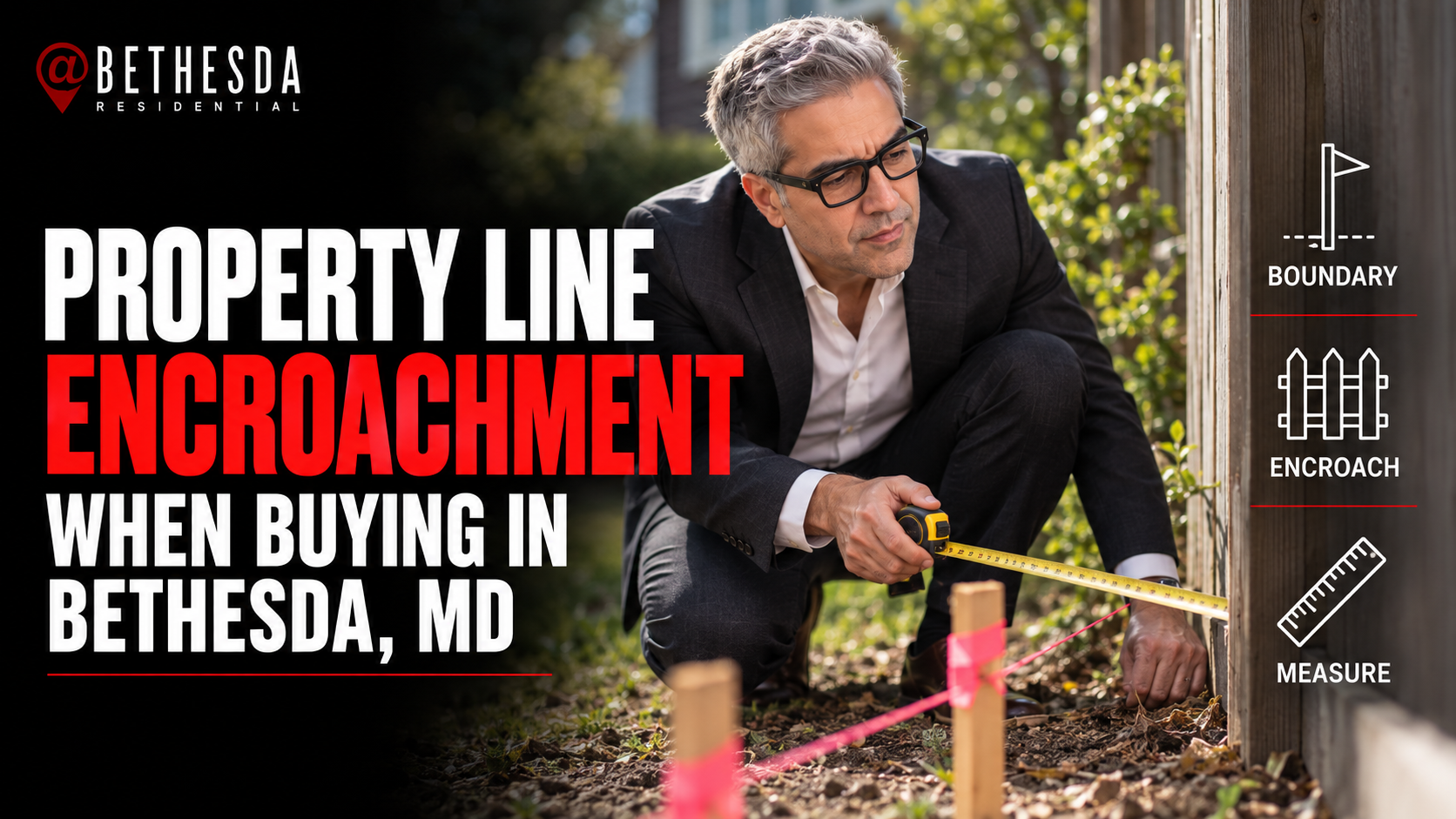
A property line encroachment happens when a structure—a fence, shed, driveway, or addition—crosses onto land you don't own, or a neighbor's improvement sits on the home you're buying. In Bethesda and Montgomery County, a boundary survey confirms it, and standard title insurance usually excludes what a survey would reveal, so you may need survey coverage or an endorsement. Because Maryland adverse possession runs 20 years, long-standing encroachments can even harden into ownership claims. Your best move is to catch it during your inspection and financing contingencies, then negotiate a fix before closing.
Quick Answer
A property line encroachment happens when a structure—a fence, shed, driveway, or addition—crosses onto land you don't own, or a neighbor's improvement sits on the home you're buying. In Bethesda and Montgomery County, a boundary survey confirms it, and standard title insurance usually excludes what a survey would reveal, so you may need survey coverage or an endorsement. Because Maryland adverse possession runs 20 years, long-standing encroachments can even harden into ownership claims. Your best move is to catch it during your inspection and financing contingencies, then negotiate a fix before closing.
You're days from closing on a home in Bethesda when the survey comes back with a red flag: the neighbor's fence sits two feet inside the lot you're buying, or the sunroom you loved extends a few inches past the side boundary. That's a property line encroachment, and it's one of the most common late-stage surprises buyers run into on Montgomery County's older, tree-lined lots.
The good news is that an encroachment rarely has to kill the deal. But it does need to be handled deliberately—before you sign, not after. Here's how to spot one, what your title insurance will and won't do, and the specific ways buyers resolve it in Bethesda.
What counts as a property line encroachment?
A property line encroachment is any structure or improvement that crosses a boundary onto land it doesn't belong to. It cuts both ways in a purchase:
- A neighbor's improvement encroaches on the home you're buying—their fence, shed, driveway, retaining wall, or overhanging deck sits on your future lot.
- The home you're buying encroaches on a neighbor—a previous owner built an addition, patio, pool, or fence that crosses onto the adjacent parcel or into an easement.
Both matter. The first can shrink the usable yard you thought you were paying for and hand a neighbor a foothold on your land. The second can become your legal problem the day you take title, from a forced relocation to a lender objection. Either way, an encroachment is different from an easement, which is a recorded right to use part of the land—an encroachment is usually unpermitted and undocumented.
How to catch an encroachment before you close
Encroachments hide in plain sight. A fence looks like a fence until someone measures. Three tools surface the problem while you still have leverage:
- A boundary (location) survey. This is the single most reliable step. A licensed Maryland surveyor stakes the actual lot lines and shows exactly where every structure sits relative to them. If you're buying in Bethesda, Chevy Chase, or Potomac, ordering a property survey during your due-diligence window is cheap insurance—expect roughly $500 to $1,500 in the DC metro depending on lot size and how overgrown the corners are, a fraction of what a boundary fight costs later.
- The title commitment. Your title company's search may flag known encroachments as exceptions. Read Schedule B closely—anything listed there is a risk the insurer is refusing to cover unless you act.
- The recorded plat and your inspection. The subdivision plat shows platted lot dimensions and building restriction lines. Pair it with your home inspection: an inspector who notes a shared driveway, a fence that doesn't match the plat, or a structure tight to the line gives you a concrete reason to survey.
Catch the encroachment during your inspection and financing contingencies and you can negotiate. Miss it, and you inherit it.
Does title insurance cover a property line encroachment?
Usually not by default—and this trips up a lot of buyers. A standard owner's title insurance policy typically excepts matters that an accurate survey would reveal, and encroachments are exactly that. So the base policy often won't protect you against a boundary structure it never inspected for.
You have a few ways to close the gap:
- Survey coverage. Providing a current survey can let the title company remove the general survey exception and insure over the lines.
- An ALTA endorsement. An encroachment endorsement can protect you against being forced to remove an improvement, or against loss if a neighbor's structure clouds your title.
- Insuring over a minor issue. When the encroachment is trivial—a fence a few inches over—the insurer may simply cover it after reviewing the survey.
None of this is automatic. You have to ask, provide the survey, and confirm in writing what the final policy actually covers before you go to settlement.
Your lender cares too. If the survey or appraisal notes a structure over the line, an underwriter can require the issue to be cleared or insured before funding. That's one more reason to raise it early—a last-minute title exception can delay settlement for everyone at the table.
Your options when a structure crosses the line
Once a survey confirms a property line encroachment, you're not stuck with a yes-or-no on the whole purchase. These are the paths buyers in Montgomery County typically take:
- Ask the seller to cure it. The cleanest fix is having the seller remove or relocate the structure, or resolve it with the neighbor, before closing.
- Negotiate a boundary line agreement. The two owners sign and record an agreement that fixes where the line is treated as being, or grants a limited right for the structure to remain. Because it's recorded, it binds future owners—so the problem doesn't resurface when you eventually sell.
- Get a price credit or escrow holdback. If you're willing to deal with it after closing, negotiate money to cover removal or future survey and legal work.
- Secure title protection. Pair survey coverage with an endorsement so a future dispute isn't your uninsured loss.
- Walk away. If the encroachment is serious—an occupied structure well over the line, or a neighbor who won't cooperate—your contingencies let you exit.
One Maryland wrinkle raises the stakes: adverse possession. In Maryland, someone who uses another's land openly and continuously for 20 years can gain a legal claim to it. A decades-old fence or driveway isn't just an eyesore—left unaddressed, it can mature into an ownership claim. That's why a long-standing encroachment deserves more scrutiny, not less, and often a conversation with a Maryland real estate attorney.
What this looks like in Bethesda and Montgomery County
This isn't a theoretical problem here. Much of Bethesda, Chevy Chase, Kensington, and older Potomac is built on mature lots where fences, sheds, and driveways have shifted or been rebuilt over 40, 60, even 80 years. Additions, decks, and pools added by prior owners—sometimes without permits pulled through Montgomery County's Department of Permitting Services—are a frequent source of boundary and setback problems.
Shared driveways and old retaining walls are especially common culprits. A wall that has held a slope for decades can sit a foot over the line, and a driveway two neighbors have shared since the 1970s may never have been formalized. None of that is fatal to a purchase—but all of it is worth confirming on paper before you own it.
If a structure truly can't stay and a neighbor won't budge, the formal remedy is a civil action in the Circuit Court for Montgomery County to establish the line or compel removal. That's expensive and slow, which is exactly why catching the encroachment before closing—when the seller still has a reason to help—matters so much.
Every lot is different, and the right move depends on how far the structure crosses, how long it's been there, and what your title company and lender will accept. That's the kind of judgment call I walk buyers through before they ever reach the settlement table.
If you're under contract in Bethesda and a survey turned up something crossing the line—or you just want to order the right survey before it does—reach out. I'm happy to help you sort out what it means and how to handle it.
About Pey Behin
Pey Behin is a residential real estate agent serving the Washington, DC metro area, with a focus on Bethesda, Montgomery County, and Northern Virginia. He works with buyers and sellers who want clear strategy, data-driven pricing, and direct guidance throughout the transaction process.