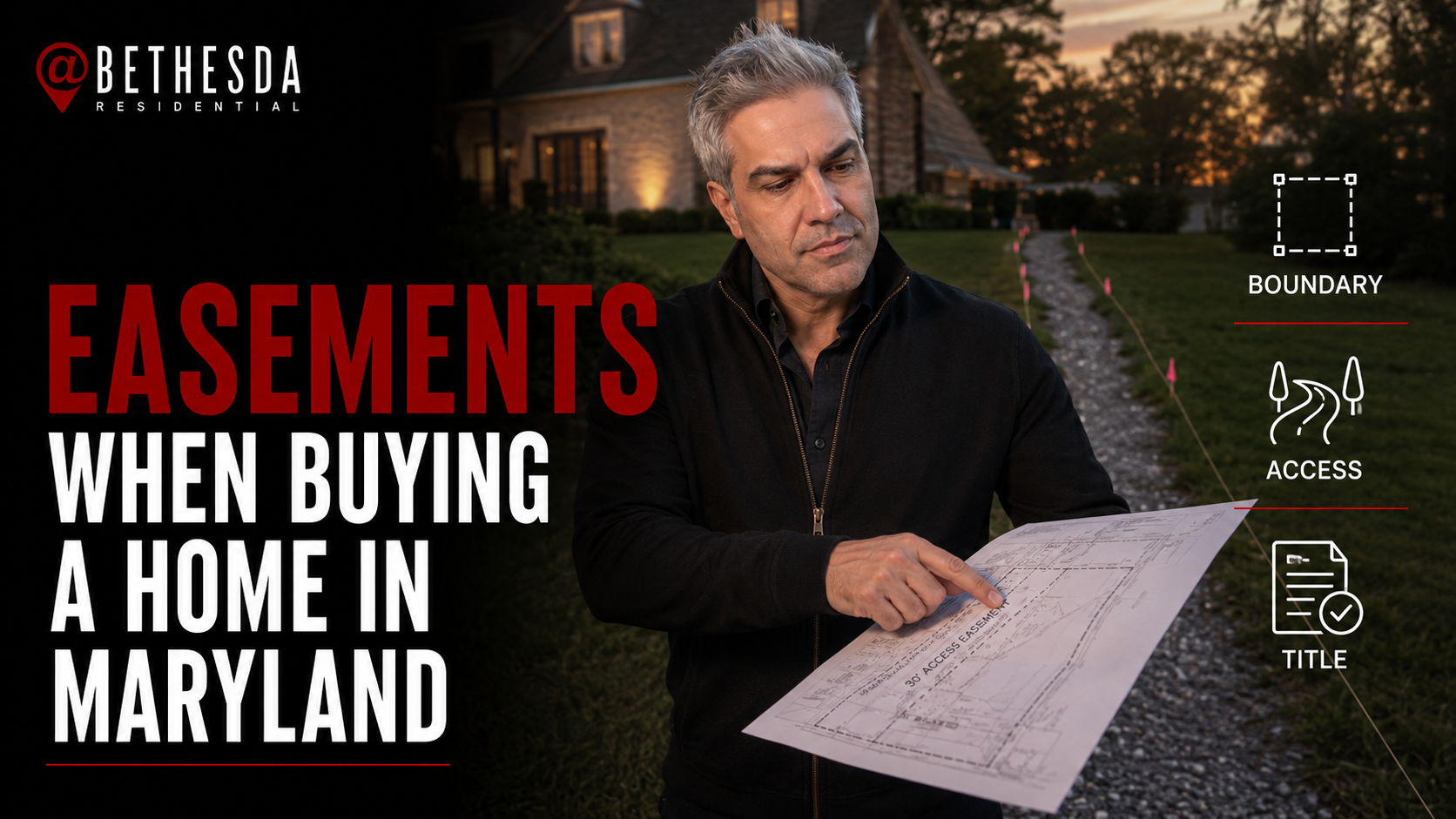
An easement gives another party — a utility, a neighbor, or the county — the legal right to use part of a property you own. In Maryland, recorded easements appear in the title search and run with the land, so they transfer to you at closing. Most are routine, but some limit where you can build, fence, or add on.
Quick Answer
An easement gives another party — a utility, a neighbor, or the county — the legal right to use part of a property you own. In Maryland, recorded easements appear in the title search and run with the land, so they transfer to you at closing. Most are routine, but some limit where you can build, fence, or add on.
You found the house. The inspection looks clean, the price works, and then the title report lands in your inbox with a line about a ten-foot easement running along the back of the lot. Suddenly you're wondering what you can actually do with the yard you're about to pay for.
Easements are one of the most common surprises in a Maryland home purchase, and one of the least understood. Handled right, most of them are a non-issue. Handled carelessly, one can quietly cost you the addition, the pool, or the fence you were counting on. Here's how to think about easements when buying a home in Maryland, what to look for, and when a single line on a plat is worth pushing back on.
What an easement actually is
An easement is a legal right for someone else to use part of your land for a specific purpose, even though you own that land and pay taxes on it. You hold the title. They hold the right to use a defined strip or area.
Two features matter most for a buyer. First, easements run with the land — they don't expire when the property changes hands, so any easement on the home you're buying transfers to you automatically at closing. You can't cancel one on your own once you own the place. Second, an easement is limited to its stated purpose. If a neighbor has a driveway easement across your lot, they can drive over it to reach their garage — they can't park on it, store things on it, or treat it as extra yard.
That combination is why easements deserve real attention before you close. You're not just buying the house. You're buying every right someone else already holds over the ground it sits on.
The easements you'll run into around Bethesda
Most Montgomery County homes carry at least one easement, and the large majority are routine. The types you'll see most often:
- Utility easements. WSSC water and sewer lines, Pepco power, gas, and cable all need access across private lots. These usually sit along the rear or side property line and rarely affect daily life — but the utility keeps the right to dig there, and you generally can't put a permanent structure on top of the line.
- Shared driveway and access easements. Common on older Bethesda and Chevy Chase streets and on Potomac flag lots, where one home reaches the road through a driveway that crosses a neighbor's land. This is an ingress/egress easement, and it's often paired with a maintenance arrangement covering who pays to repave and plow.
- Storm drain and drainage easements. Montgomery County holds the right to reach and maintain drainage infrastructure. A fence or shed placed inside one can be removed by the county — sometimes without reimbursing you.
- Conservation and forest easements. More common on larger Potomac and North Potomac lots. These are agreements — often with the Maryland Environmental Trust or tied to the county's Forest Conservation Law — that permanently restrict clearing, building, or developing part of the land.
- Prescriptive easements. The tricky ones. In Maryland, someone who uses part of your land openly and continuously for roughly 20 years can acquire a legal right to keep doing it — a neighbor's footpath, a shared fence line, a spot where cars have always turned around. These frequently aren't recorded anywhere.
The distinction that matters: a utility easement along the back line generally doesn't change what a home is worth. A conservation easement that locks up half a Potomac lot, or a shared driveway with a long-running dispute attached, absolutely can.
How to find easements when buying a home in Maryland
You have three tools, and you want all three working together:
- The seller's disclosure. Maryland sellers complete the Residential Property Disclosure and Disclaimer Statement, and a seller who knows about an easement, boundary dispute, or shared driveway arrangement is expected to disclose it. Read it closely — but don't lean on it alone, because sellers only have to disclose what they actually know.
- The title search. Your title company pulls the land records and flags every recorded easement attached to the property, so recorded utility, access, and conservation easements will surface here. This is also why owner's title insurance matters — though be aware that most standard policies carry a "survey exception" that limits coverage for boundary and easement problems a survey would have caught.
- A survey. A location drawing or boundary survey is the only tool that shows you where an easement physically sits on the lot. A title report can tell you a ten-foot utility easement exists; a survey shows you it runs straight through the spot where you pictured the addition.
Recorded easements are the easy case. The harder ones are unrecorded — a prescriptive easement or an informal shared-driveway habit that never made it into the land records. You catch those by walking the property, asking direct questions, and looking for worn paths, shared fences, or a driveway that clearly serves more than one home. If you're buying into an HOA or condominium, shared-use rights and common-area easements also show up in the HOA resale package, so read that section rather than skimming it.
What an easement means for your offer
Once you know what you're dealing with, the real question is whether it changes the deal. Run it through three filters.
Does it limit what you actually want to do? If you're buying to live in the home as it stands, a rear utility easement is background noise. If you're buying with plans to add a second story, put in a pool, or fence the yard, an easement across the relevant part of the lot is a genuine constraint. In Montgomery County, placing a fence inside a county drainage or utility easement usually requires county approval and a recorded covenant that lets the county remove the fence later — at your cost — if it needs access.
Is it already priced in? Often it is. A lot burdened by a heavy easement may already sit below comparable homes without one. The problem is when the discount isn't there, or when you didn't learn about the easement until late in the process and it wasn't reflected in what you offered.
Can you build, add, or fence where you need to? For anything beyond routine use, confirm directly with the party that holds the easement — WSSC, Pepco, or Montgomery County Permitting Services — before you're committed, not after. Their answer is what governs, not the seller's assurance.
If an easement genuinely undercuts your plans, you have room: negotiate a price reduction, ask the seller to resolve or formally clarify it, or exercise your contingency and walk. Weighing easements when buying a home is exactly the kind of due diligence I walk buyers through before we remove contingencies — because a single line on a plat can be nothing, or it can be the reason a house quietly doesn't work for you.
The bottom line
Most easements you'll encounter buying in Bethesda, Potomac, or Chevy Chase are ordinary and won't change how you use your home. The goal isn't to fear them. It's to find them early, understand exactly what each one allows, and make sure the one that matters doesn't surprise you after you've handed over the keys.
If you're weighing a home with an easement and want a straight read on whether it's a non-issue or a real problem, I'm happy to walk through it with you. Reach out anytime.
About Pey Behin
Pey Behin is a residential real estate agent serving the Washington, DC metro area, with a focus on Bethesda, Montgomery County, and Northern Virginia. He works with buyers and sellers who want clear strategy, data-driven pricing, and direct guidance throughout the transaction process.