
TLDR
Strategic underpricing can create competition. Emotional underpricing creates regret. In Bethesda, pricing slightly below market can generate multiple offers, but only when supported by demand, condition, and timing.
The Psychology of Pricing
Pricing is not math alone. It is behavioral economics.
Buyers respond to:
Perceived value
Competitive urgency
Fear of missing out
Comparative positioning
A home priced slightly below its value band often attracts more attention and more showings within the first 7 days.
The first week determines momentum.
What “Below Market” Actually Means
It does not mean:
10 percent under value
“Let’s see what happens”
Ignoring comparable sales
It means:
Positioning at the bottom of the value range supported by comps.
Example:
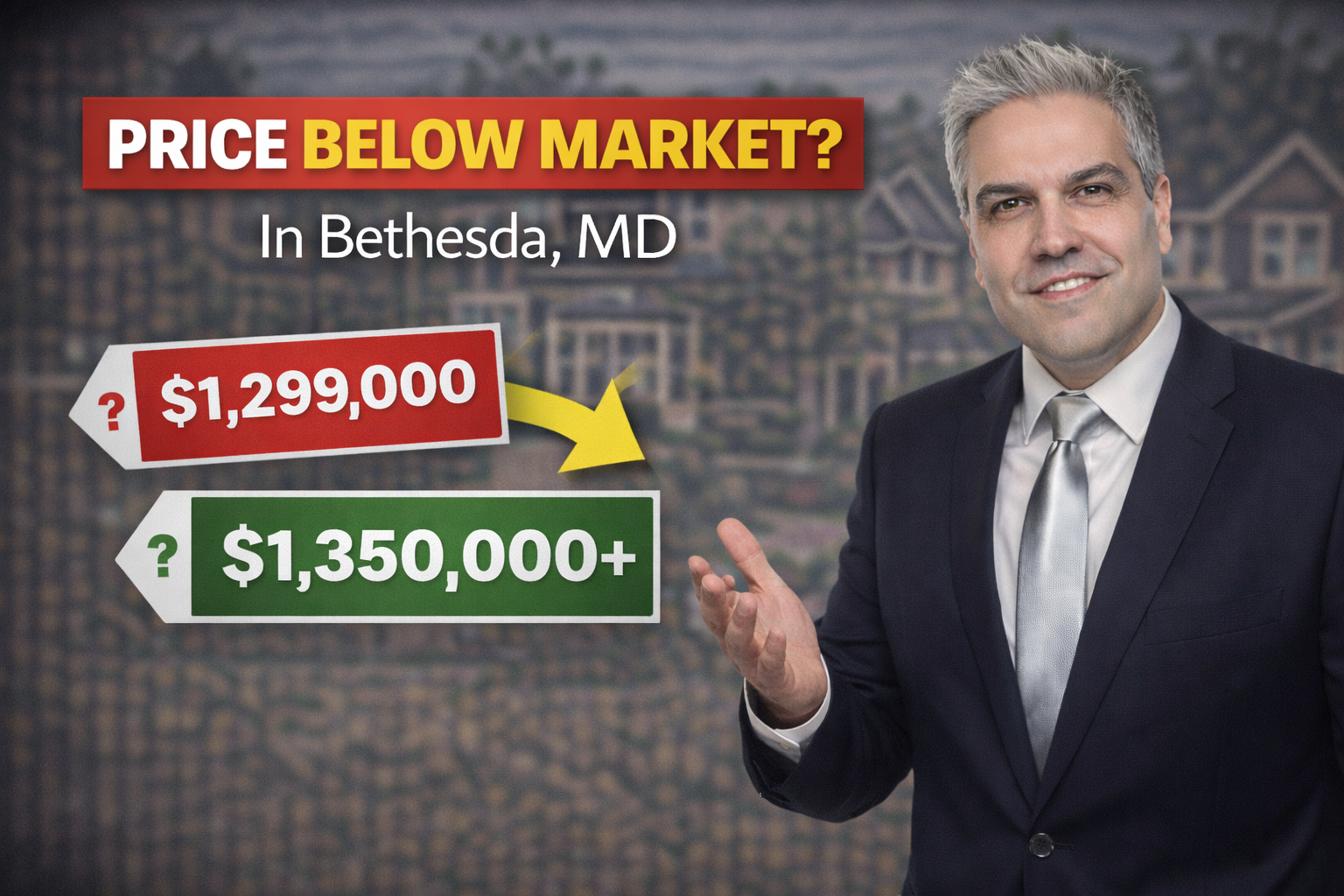
If market-supported value is $1.35M–$1.4M, pricing at $1.349M may create competitive tension.
Pricing at $1.299M introduces risk.
When This Strategy Works in Bethesda
This approach works best when:
Inventory is tight
Demand is active
The home shows well
The property is in a high-demand school cluster
Comparable homes recently received multiple offers
Bethesda neighborhoods with strong spring activity often respond well to this tactic.
When It Backfires
Underpricing can fail when:
Buyer demand is soft
Competing inventory is high
The home needs work
Luxury price tiers above $2.5M have limited buyer pools
The pricing gap is too large
If competition does not materialize, you anchor the market lower.
The First-Week Rule
In Bethesda, the first 5 to 10 days carry disproportionate influence.
Strong launch:
High showing volume
Offer deadlines
Escalations
Clean contingencies
Weak launch:
Price reductions
Days on market accumulation
Negotiation from weakness
Momentum compounds.
The Risk Calculation
The question is not:
“Can we get more?”
The question is:
“Will competition push it higher?”
Competition sets ceilings.
Negotiation sets floors.
A Controlled Strategy
If underpricing is used, it should include:
Defined offer deadline
Pre-marketing exposure
Professional staging
Strong MLS presentation
Appraisal risk planning
It is not a gamble. It is engineered pressure.
FAQs
Does pricing low guarantee multiple offers?
No. Demand conditions determine outcome.
Can pricing slightly below market increase final price?
Yes, if competition materializes.
What if only one offer comes in?
Then pricing leverage decreases, and renegotiation risk increases.
Is this strategy common in Bethesda?
It is common in competitive segments under $2M.
Should luxury homes use this tactic?
Luxury pricing requires narrower positioning. Underpricing is riskier in that tier.
Conclusion
Pricing slightly below market can be powerful.
But only when market demand is strong enough to respond.
In Bethesda, strategic positioning matters more than emotional optimism.
Legal Disclaimer
This article is for informational purposes only and does not constitute financial advice. Pricing strategies should be tailored to specific property conditions and market data.
Check out this article next