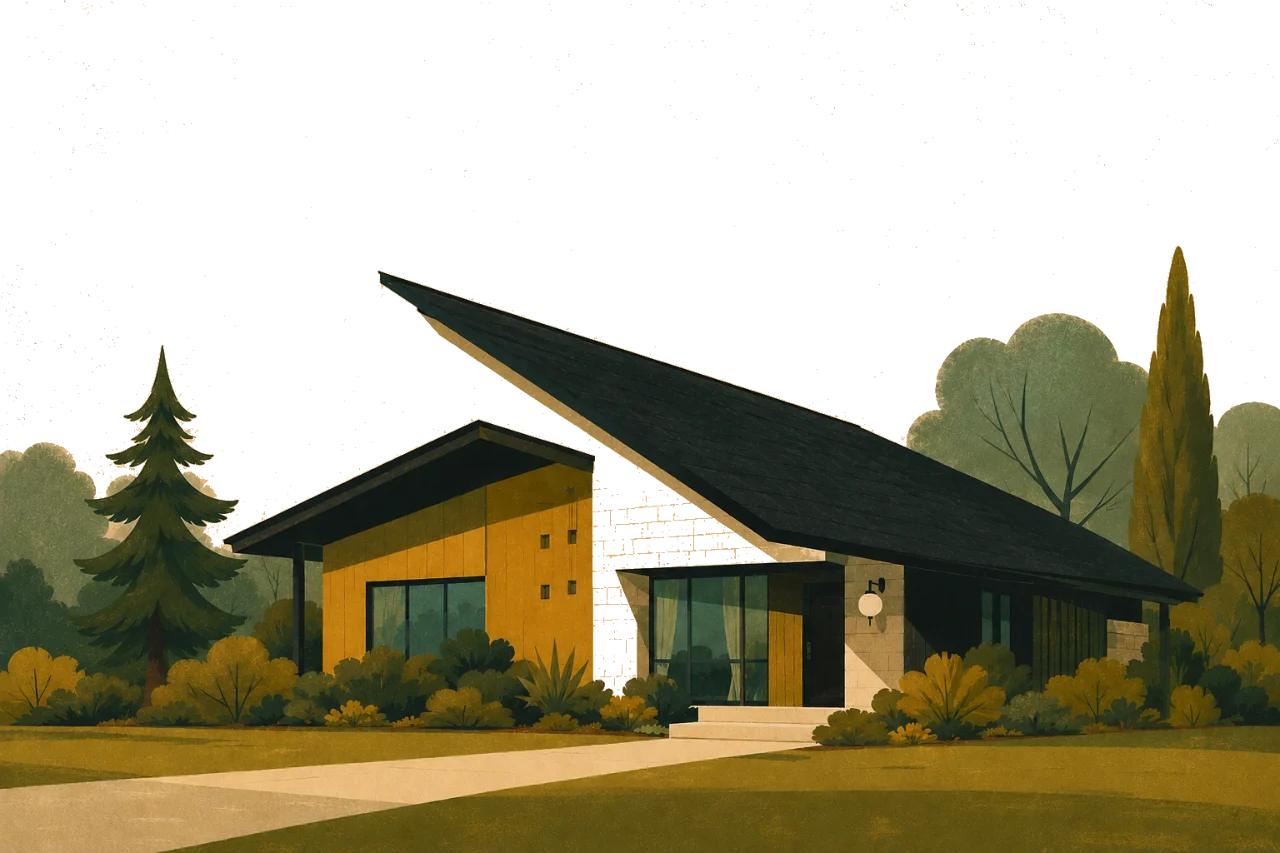
A planned mid-century modern community designed around winding roads, preserved trees, and postwar modern architecture. Early 1950s. Keyes, Smith & Satterlee, Architects.
Five basic floor plan types with twenty variations gave the community internal diversity while maintaining a coherent modernist character.
Houses grouped around circular drives and winding roads that followed natural land contours — a departure from postwar rectilinear grid planning.
Existing trees were preserved during development. The mature wooded canopy cannot be replicated on a cleared site — an irreplaceable asset.
Compact plans with large glass walls blurring the interior-exterior boundary. Open layouts and outdoor access were original priorities, not retrofits.
Pine Spring was planned and developed in the early 1950s as a deliberate exercise in applied mid-century modern residential design — conceived not as a speculative subdivision but as a planned community with a unified architectural framework.
The development was designed by Keyes, Smith & Satterlee, Architects, with Francis D. Lethbridge serving as associate architect. Rather than imposing a standard grid, the site plan organized homes around circular drives and winding roads that followed natural topography.
Existing trees were preserved wherever feasible. The decision to retain mature vegetation rather than start from a cleared site is part of what gives Pine Spring its distinctive character today — character that cannot be reproduced regardless of what is built on a cleared lot.
Construction was carried out by Luria Brothers Builders. Homes were developed from five basic floor plans with twenty variations, giving the community internal architectural variety while maintaining a coherent modernist vocabulary throughout. The result is one of the more carefully considered planned MCM communities in Northern Virginia.
Pine Spring is in the Falls Church area of Fairfax County, Virginia — a close-in Northern Virginia suburb. The neighborhood is part of Fairfax County; confirm addresses, zoning, and jurisdiction details independently.
Served by Fairfax County Public Schools. Verify specific assignments by address at FCPS.
Mature wooded setting with preserved trees throughout the residential streets.
Access to Northern Virginia’s road network and regional amenities. Verify routes per address.
An established residential setting with a distinct architectural identity.
Pine Spring homes should be evaluated differently than conventional suburban listings. Floor plan integrity, window placement, rooflines, site orientation, and what has been altered all affect value in ways standard comparables miss.
View HomesA Pine Spring listing should not be marketed like a generic Northern Virginia home. Architecture, development history, original plan variations, wooded setting, and preservation-sensitive updates are all part of correct positioning.
Get Home ValueNo. Pine Spring is in the Falls Church area of Fairfax County, Virginia — not in Bethesda, Maryland. It appears on @Bethesda Residential because this site covers notable MCM neighborhoods across the DC, Maryland, and Virginia region.
Keyes, Smith & Satterlee, Architects, with Francis D. Lethbridge as associate architect.
Pine Spring was planned in the early 1950s as a unified MCM community. Homes are grouped around circular drives and winding roads following natural land contours. Existing trees were preserved. Five basic floor plans with twenty variations were used throughout.
Pine Spring was built by Luria Brothers Builders.
Primarily ramblers, split-levels, and two-story designs from five basic floor plans with twenty variations. Many retain original MCM features including flat or low-pitched rooflines, large picture windows, and open plans. Condition and preservation vary significantly by property.
No. School assignments in Fairfax County vary by address and can change over time. Buyers should verify directly with Fairfax County Public Schools before relying on any assignment.
Evaluate floor plan integrity, window placement, roofline profile, site orientation, what has been added or altered, and mechanical systems. A renovated home and a preserved original can appeal to very different buyers at very different price points.
Current listings are shown above via live MLS data. For off-market opportunities or a guided search, contact Pey Behin directly.
Wooded Bethesda neighborhood with a distinctive mix of modernist and contemporary homes.
Explore →Bethesda modernist neighborhood known for wooded lots and architecture-sensitive renovations.
Explore →Reston cluster community tied to the region’s planned-community modernist history.
Explore →Kensington-area MCM neighborhood with compact modern homes and wooded streets.
Explore →Modernist enclave known for architecture integrated with a wooded setting.
Explore →We specialize in mid-century modern neighborhoods across the DC, Maryland, and Virginia region. If Pine Spring interests you, let’s talk.