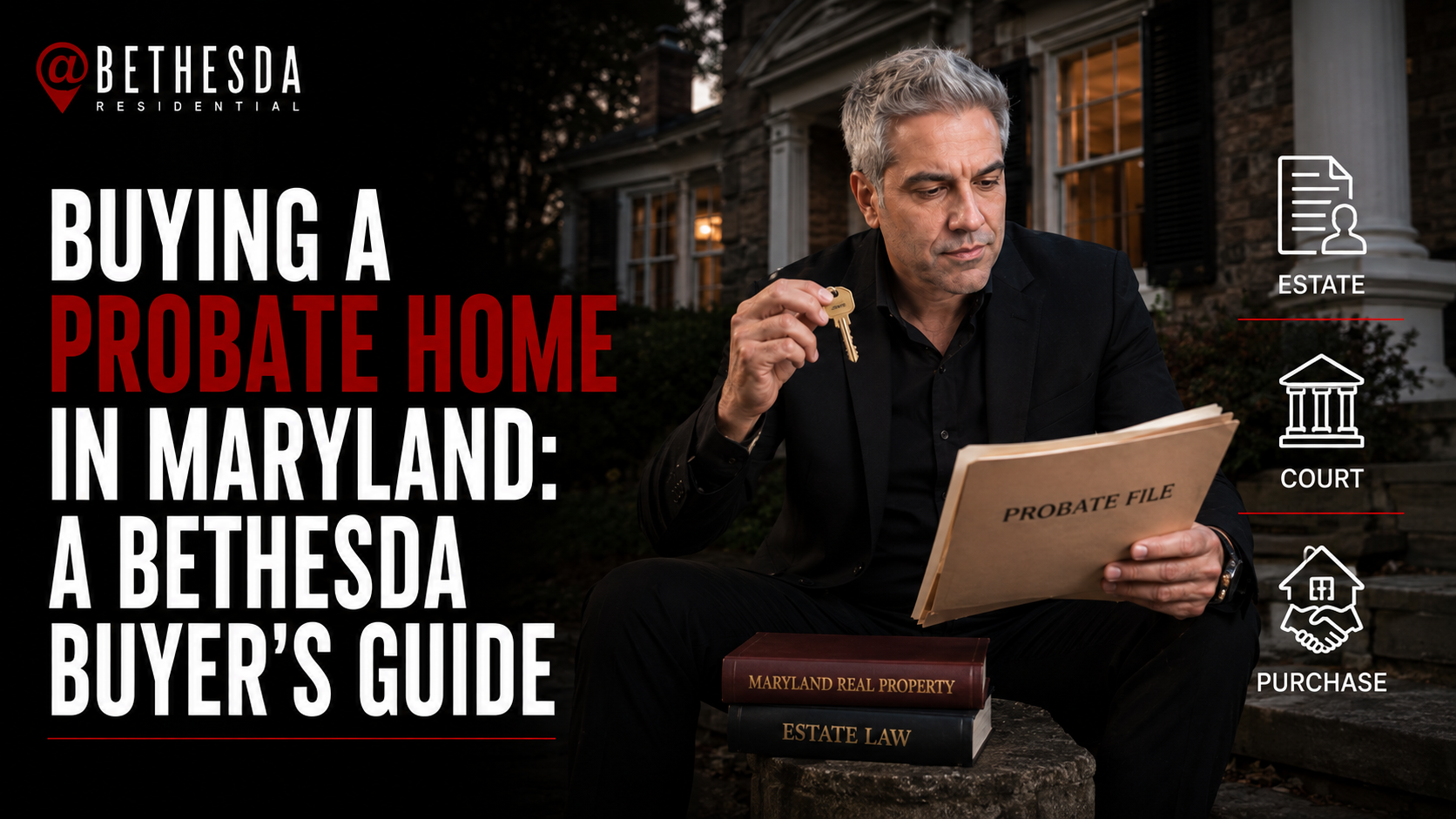
Buying a probate home in Maryland means purchasing from a deceased owner's estate through a court-supervised process — usually as-is and with limited disclosure. In Montgomery County, the sale runs through the Register of Wills and Orphans' Court in Rockville, and start to finish it can take anywhere from a few months to well over a year. Your biggest risks are unpaid liens and title defects left by the prior owner, so a full title search and owner's title insurance are non-negotiable. Handled right, the reduced buyer competition on these homes can turn into real value.
Quick Answer
Buying a probate home in Maryland means purchasing from a deceased owner's estate through a court-supervised process — usually as-is and with limited disclosure. In Montgomery County, the sale runs through the Register of Wills and Orphans' Court in Rockville, and start to finish it can take anywhere from a few months to well over a year. Your biggest risks are unpaid liens and title defects left by the prior owner, so a full title search and owner's title insurance are non-negotiable. Handled right, the reduced buyer competition on these homes can turn into real value.
You found a house you like, the price looks a little soft for the block, and then you see it: "estate sale" or "sold as part of probate." Before you get excited about the deal — or scared off by the word "probate" — it helps to know exactly what you're stepping into.
Probate homes come to market when an owner passes away and their property has to be sold through the estate. In Bethesda, Potomac, Chevy Chase, and across Montgomery County, these sales show up regularly, often on older homes that have been in one family for decades. The opportunity is real. So is the extra homework. Here's how these purchases work in Maryland and what you need to watch for before you write an offer.
What Buying a Probate Home in Maryland Actually Means
Buying a probate home in Maryland means purchasing real estate from a deceased owner's estate rather than from a living seller. Because the original owner can't sign anything, the sale is handled by a personal representative — the person the court appoints to settle the estate (you may also hear "executor" if there was a will).
That single difference drives almost everything else about the transaction:
- The seller never lived in the home. The personal representative is often an out-of-town adult child or a relative who has no firsthand knowledge of the roof, the HVAC, or that quiet basement leak.
- Disclosure is limited. Maryland lets sellers disclose based on actual knowledge. A personal representative who never occupied the property can honestly say they don't know — which shifts the burden of investigation onto you.
- The home is almost always sold as-is. The estate wants to close and distribute the proceeds, not sink money into repairs.
- The timeline runs on the court's clock, not yours. Parts of the sale can hinge on estate administration steps that you don't control.
None of that makes a probate purchase a bad idea. It just means the usual buyer protections are thinner, so you have to build your own.
How the Montgomery County Probate Sale Process Works
Every Maryland estate is administered at the county level. For homes in Bethesda and the rest of the county, that means the Montgomery County Register of Wills and the Orphans' Court, both in Rockville. Here's the shape of the process from a buyer's point of view.
1. The estate is opened and a personal representative is appointed. Nothing can be sold until the court grants someone the legal authority to act for the estate. Maryland uses a streamlined "summary" administration for smaller estates — generally those under $50,000, or under $100,000 when the sole heir is a surviving spouse — and a longer "regular" administration for everything above that. Most homes fall into regular administration.
2. The property is listed and priced. The personal representative typically hires an agent, gets an appraisal or valuation, and brings the home to market. This is where you come in as a buyer.
3. The sale is authorized. Whether the personal representative needs a separate court sign-off depends on the will. If the will explicitly grants the power to sell real estate, the representative can often proceed directly. If it doesn't — or if there's no will — the representative may have to file a petition and get the Orphans' Court to authorize the sale. Ask early which path applies, because it affects your timeline.
4. You close through a title company. Settlement works much like a standard Maryland purchase, but the title company will confirm the estate's authority to convey and clear anything owed by the deceased before you take ownership.
Start to finish, a Maryland probate sale commonly runs anywhere from a few months to well over a year. If you're on a tight moving deadline — a lease ending, a school-year target, a rate lock — build in cushion and get realistic answers about where the estate is in the process before you fall in love with the house.
The Risks Buyers Take On — and How to Protect Yourself
The word buyers should focus on isn't "probate." It's diligence. Here are the four risks that matter most and the concrete way to handle each.
Title and liens
This is the big one. A deceased owner can leave behind an unpaid mortgage, back property taxes, a mechanic's lien from an unpaid contractor, or a judgment that attaches to the property. These don't vanish because the owner passed — they have to be cleared before clean title transfers to you.
Protect yourself two ways: order a full title search early, and buy an owner's title insurance policy. A careful Maryland title search surfaces the liens; a Maryland owner's title insurance policy protects you if something slips through anyway. On a probate purchase, neither is optional.
Condition
An as-is sale means you accept the home in its current state, but it does not mean you skip the inspection. Keep your inspection contingency and use it as information, even if you won't ask the estate to make repairs. A home that's sat empty for a year can hide a failed water heater, pests, or a roof at the end of its life. Older Bethesda and Chevy Chase homes may also carry the usual vintage issues — knob-and-tube wiring, an aging oil tank, or materials worth testing. Inspect fully, then price your offer to the reality.
Disclosure gaps
Because the estate's disclosure will likely be thin, you have to do the digging a live seller might have handed you. Pull permit history from Montgomery County, confirm the septic or sewer situation if it's not on public water, and verify there are no open code cases. When in doubt, test rather than assume.
Timeline and certainty
Estate steps, heir approvals, or a required court authorization can slow your close. Family members are sometimes allowed to weigh in on the sale, which can add friction. Write realistic contingency dates, keep your financing flexible, and don't waive protections just to look competitive — the whole point of buying a probate home in Maryland is to get value with your safeguards intact, not to trade them away.
Is a Probate Home Worth It for a Bethesda Buyer?
For the right buyer, yes. Probate homes can trade below a fully renovated comp because the estate prioritizes a clean, timely sale over squeezing out the last dollar, and because many buyers self-select out the moment they see the word. If you're comfortable with an as-is condition and you do your title and inspection homework, that reduced competition can work in your favor — especially on the older, well-located homes that don't come up often in neighborhoods like Bethesda and Potomac.
It's the wrong fit if you need certainty on your closing date, you have no cushion for repairs, or you can't stomach a process where the timeline partly belongs to the court. And it's worth remembering the other side of the table: the seller-side version of this, selling an inherited home in Bethesda, comes with its own set of tax and timing questions. If you're weighing distressed purchases more broadly, the diligence mindset carries straight over to buying a foreclosure in Maryland, too.
The bottom line: a probate home is a normal purchase wearing extra paperwork. Understand the Montgomery County process, protect your title, inspect like you mean it, and the "scary" label often turns into a genuine opportunity.
If you're looking at a specific estate listing in Bethesda or anywhere in Montgomery County and want a straight read on the risks and the number, I'm happy to walk through it with you. Reach out anytime.
About Pey Behin
Pey Behin is a residential real estate agent serving the Washington, DC metro area, with a focus on Bethesda, Montgomery County, and Northern Virginia. He works with buyers and sellers who want clear strategy, data-driven pricing, and direct guidance throughout the transaction process.