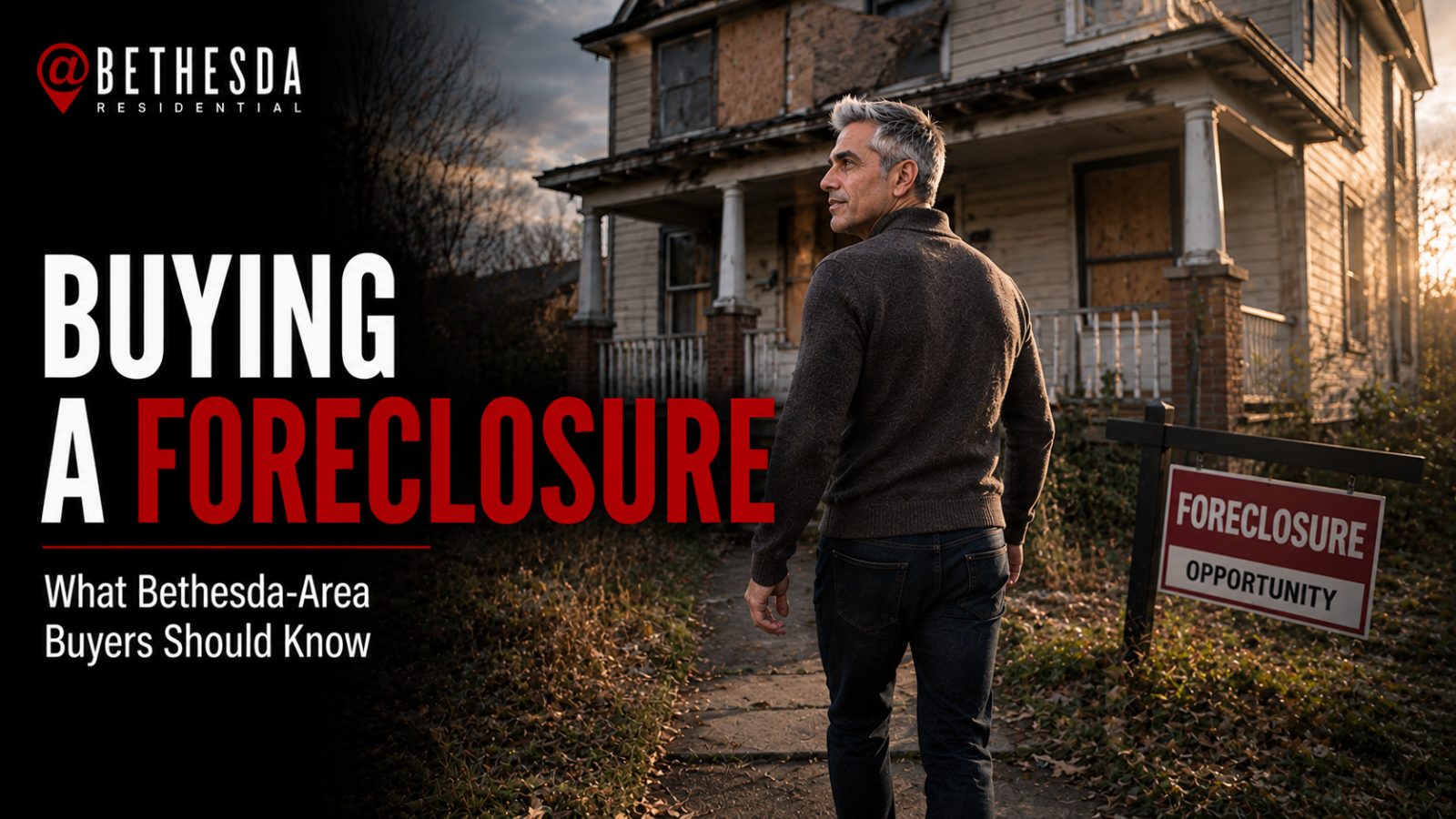
Buying a foreclosure in Maryland means a court-supervised auction, 45–180-day ratification, and as-is conditions with no seller disclosures. REO (bank-owned) properties are more accessible — MLS-listed, inspectable, and financeable — but still require extra title and condition due diligence.
Quick Answer
Buying a foreclosure in Maryland means a court-supervised auction, 45–180-day ratification, and as-is conditions with no seller disclosures. REO (bank-owned) properties are more accessible — MLS-listed, inspectable, and financeable — but still require extra title and condition due diligence.
Foreclosures look like deals from the outside. They sometimes are. But buying a foreclosure in Maryland is a fundamentally different process than a standard resale purchase — and if you don't understand how Maryland's system works before you bid, you can lose your deposit, inherit title problems, or end up with a property you can't finance.
Here's what you actually need to know.
What Buying a Foreclosure in Maryland Actually Means
Maryland is a judicial foreclosure state. That means a lender can't simply foreclose and sell — they have to file an action in Circuit Court, give the homeowner proper notice (at least 90 days), and have the sale supervised and ratified by a judge. This protects homeowners, but it also makes the process longer and more complex for buyers than in non-judicial states.
There are two main ways to buy a foreclosure in Maryland:
- Courthouse auction — You bid at a public auction, typically held at the County Circuit Court. In Montgomery County, foreclosure auctions take place at the Circuit Court for Montgomery County, 50 Maryland Avenue, Rockville, MD 20850. If you win, the sale still requires court ratification before you can close.
- REO (Real Estate Owned) — If no one bids enough at auction, the lender takes title and the property becomes "bank-owned" or REO. The bank then lists it on the open market, often through a real estate agent, much like a standard listing.
Both paths involve buying as-is with no seller disclosure form. But they're very different experiences for a buyer.
Courthouse Auctions: What to Expect
Bidding at a foreclosure auction in Maryland is not like making an offer on a resale home. Before you show up, understand what you're walking into.
- Bring a certified or cashier's check. The required deposit amount is stated in the auction advertisement. No personal checks are accepted. If you win and can't complete settlement, your deposit is non-refundable — and the property can be resold at your risk and expense.
- You won't see the inside. The trustee and auctioneer generally don't have access to the property before the auction. You can walk the exterior, but entering without permission — even if the home appears vacant — isn't allowed. You're bidding on what you can see from the curb and what you find in the public record.
- Ratification takes 45–180 days. After winning the auction, the sale can't be finalized until the Circuit Court ratifies it. Ratification cannot begin until 30 days after the auction is held, and depending on the county and whether exceptions are filed, it can take 45–180 days or longer. This is not a fast process.
- Cash or hard money only. Traditional mortgage financing almost never works for courthouse auctions — the as-is, no-access conditions and extended timeline don't meet lender requirements. Most buyers either pay cash or use a hard money lender (expect rates of 12–16% and origination fees of 2–3 points). Most serious bidders use cash; hard money loan costs add up quickly on a Bethesda-range property.
- No seller disclosures. The bank or trustee does not complete a Maryland Residential Property Disclosure and Disclaimer Statement. You're buying without any knowledge of the property's condition, known defects, or repair history.
Courthouse auctions in the Bethesda, Potomac, and North Bethesda market — the $700,000–$2,000,000 price range — are less common than in lower-price-point areas, but they do occur, particularly on properties where jumbo loan borrowers defaulted.
REO Properties: The More Accessible Route
REO properties are former foreclosures that didn't sell at auction. The lender now owns them outright and typically lists them on the MLS. You can find them through a real estate agent, schedule a showing, and make an offer using a standard contract with contingencies — a much more manageable process than a courthouse auction.
You can usually inspect the property. Banks generally allow buyers to conduct home inspections on REO properties. This is a significant advantage over auction buying — you can verify actual condition before you're locked in.
Standard financing is possible — with conditions. If the property is in livable condition (working systems, no major structural damage, intact roof), conventional financing typically works. FHA loans are trickier: the program requires properties to meet Minimum Property Requirements (MPR), and many foreclosures have deferred maintenance, missing appliances, or compromised systems that make them ineligible. If you're planning to use FHA financing, get your lender to assess the property's condition before you go under contract.
Banks move slowly on offers. REO offers are reviewed by asset managers, committees, and sometimes investors — not a motivated seller. Expect days or weeks for a response, and expect a counteroffer. Banks are required to demonstrate they pursued maximum value, so even on distressed properties, lowball offers get pushed back hard.
Still as-is, still no disclosure. The bank won't agree to repairs and won't complete a seller disclosure form. A thorough home inspection is essential here — and budget for what you find, because you're not getting a repair credit after the fact.
Title Risk: The Complication Most Buyers Miss
This is where foreclosure deals quietly fall apart for buyers who didn't do their homework upfront.
When a lender forecloses, they extinguish their own lien — but not necessarily all liens on the property. Depending on lien priority and how the foreclosure was conducted:
- IRS federal tax liens may survive foreclosure if the IRS wasn't properly notified during the process.
- Mechanic's liens and unpaid contractor debts can survive if they were filed before the foreclosure was initiated.
- HOA dues and special assessments can follow the property in some circumstances.
For courthouse auction buyers: a title search before you bid is essential. You need to know what's attached to the property before you commit that certified check.
For REO buyers: the bank's title company typically clears most liens before listing, but an owner's title insurance policy is more important here than on any standard purchase. If a lien surfaces after closing that wasn't disclosed or resolved, your title policy is the protection you need.
Running the Real Numbers Before You Bid
A foreclosure can be a genuine deal — but the math is more involved than "purchase price vs. comparable sales." Before you bid at auction or make an offer on an REO, account for:
- Closing costs follow the same Maryland structure as any purchase — transfer and recordation taxes, title fees, lender fees. See the full breakdown in our guide to buyer closing costs in Bethesda.
- Deferred maintenance and rehab. A home vacant for 6–18 months in Montgomery County's climate can have HVAC, plumbing, roof, or siding issues that aren't visible on the exterior. Budget conservatively and then add a contingency reserve on top of that.
- Radon testing. Many older Bethesda, Potomac, and Chevy Chase properties have radon levels that require mitigation — and a vacant, unsealed home may have elevated readings. Plan to test after closing. See our guide to radon testing in Montgomery County for what to expect and what mitigation typically costs.
- Carrying costs at auction. If you're using cash at a courthouse auction and waiting 6+ months for ratification, that's months of opportunity cost on capital, plus property taxes that start accruing after ratification.
Run the numbers with your eyes open: purchase price + estimated repairs + closing costs + carrying costs. Then compare that total to what comparable move-in-ready homes are selling for in the same neighborhood. Sometimes the foreclosure is still the better deal. Sometimes the premium on a clean resale is worth it.
Is buying a foreclosure in Maryland the right move for your situation? It depends on the specific property, your financing options, your risk tolerance, and your ability to accurately estimate rehab costs. I walk clients through exactly this analysis when a foreclosure comes up in their search — running the true cost picture before they fall in love with the price. If you're evaluating a foreclosure in Bethesda, Potomac, Chevy Chase, or North Bethesda, reach out and let's look at the numbers together.
About Pey Behin
Pey Behin is a residential real estate agent serving the Washington, DC metro area, with a focus on Bethesda, Montgomery County, and Northern Virginia. He works with buyers and sellers who want clear strategy, data-driven pricing, and direct guidance throughout the transaction process.