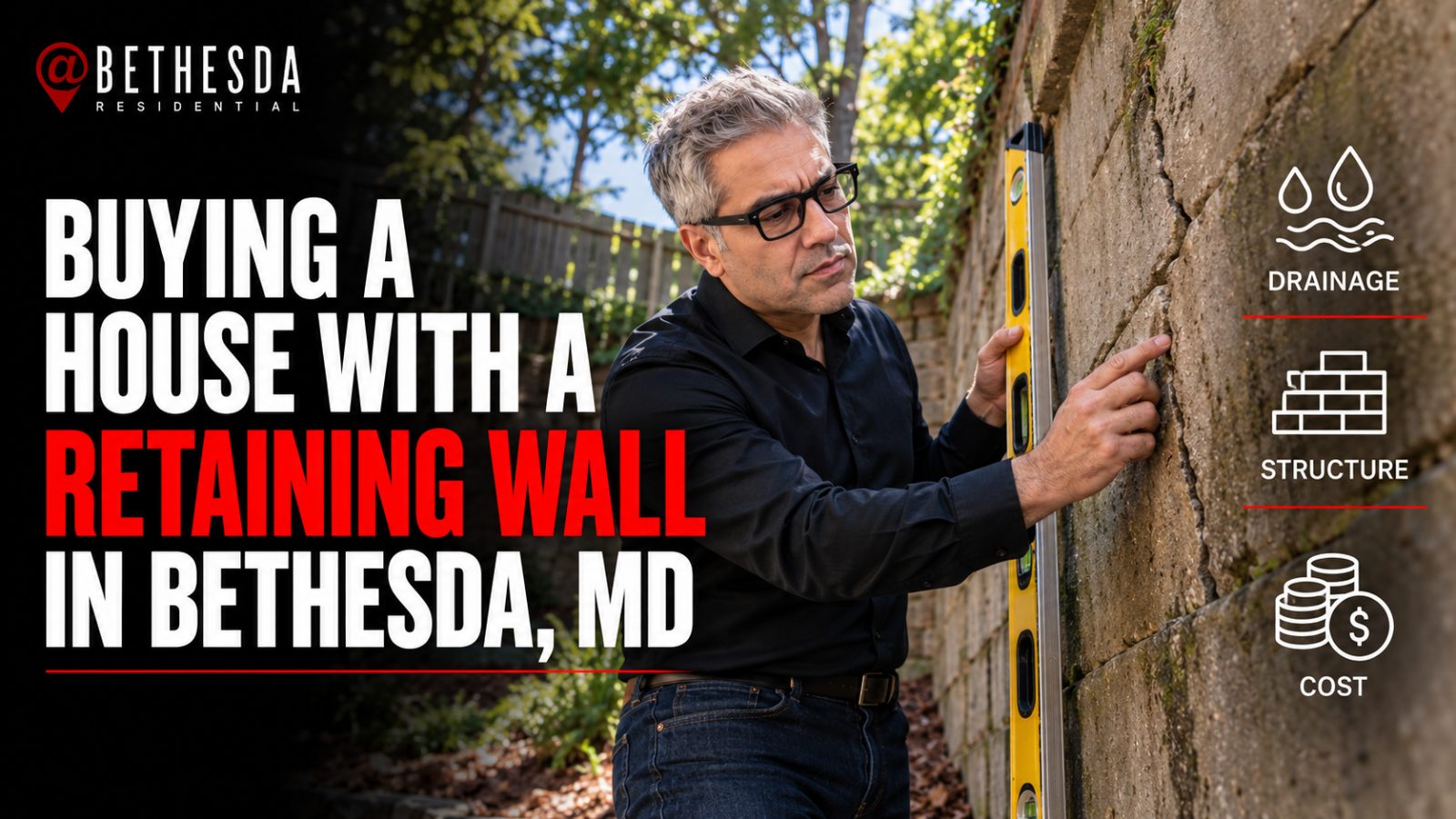
A retaining wall rarely has to kill a Bethesda home purchase, but it isn't cosmetic. A failing wall can cost $6,000 to $14,000 or more to replace, and in Montgomery County any wall over 4 feet tall — or any wall holding back a slope — needs a DPS building permit. Have it inspected, confirm who owns it on the survey, and negotiate repairs or a price credit before you close.
Quick Answer
A retaining wall rarely has to kill a Bethesda home purchase, but it isn't cosmetic. A failing wall can cost $6,000 to $14,000 or more to replace, and in Montgomery County any wall over 4 feet tall — or any wall holding back a slope — needs a DPS building permit. Have it inspected, confirm who owns it on the survey, and negotiate repairs or a price credit before you close.
On the hillier lots around Bethesda, Potomac, and Chevy Chase, retaining walls are everywhere — holding up a terraced backyard, a raised driveway, a garden bed, or the grade between you and the house next door. Most of the time they do their job quietly for decades. But when a wall is leaning, cracking, or quietly washing out, it can turn into a five-figure problem, and it isn't always obvious who's on the hook to fix it.
Here's the reassuring part: a retaining wall almost never has to kill a deal. What it needs is the right homework before you remove your contingencies. Buying a house with a retaining wall comes down to three questions — is it failing, who is responsible for it, and what will it cost to deal with — and you can get clear answers on all three before you ever get to the closing table.
What to check before buying a house with a retaining wall
Treat the wall as its own inspection item, not a footnote on the back page of the report. A standard home inspection will flag an obviously failing wall, but inspectors aren't structural engineers, and a tall or load-bearing wall deserves a closer look.
Walk the length of the wall and look for the warning signs that separate ordinary age from real structural trouble:
- Leaning or tilting away from the slope it's holding back — even a few degrees matters.
- Bulging or bowing in the middle, where soil pressure is winning.
- Cracking, crumbling, or separating blocks, timbers, or mortar joints.
- Blocks sliding out of line, or the top course creeping forward.
- Water staining, efflorescence (that white mineral residue), or soggy ground at the base — a drainage problem, which is the number-one cause of wall failure.
- Soil washing out from behind the wall or settling on the high side.
Drainage is usually the real story. A wall fails when water builds up behind it with nowhere to go, so working weep holes, a gravel backfill, and a functioning drain line matter as much as the wall material itself. If the wall is tall, holds back a driveway or pool, or shows any of the signs above, pay for a structural engineer's evaluation — typically $350 to $750 in this market — during your inspection window. That report doubles as your best negotiating tool. It's the same logic I use for any big structural question, which is why I tell buyers to treat a questionable wall the way they'd treat foundation problems: get a specialist's number, not a guess.
Who's responsible for a retaining wall on the property line?
This is the question that catches buyers off guard, and it's far better sorted out before closing than after. Responsibility generally follows ownership and location:
- Entirely on the home you're buying: it's your wall, your maintenance, and your cost.
- On the neighbor's lot but holding up your land (or the reverse): the picture gets more complicated, and the doctrine of "lateral support" — your right to have your land supported in its natural state — can come into play.
- Straddling the property line: it's frequently a shared responsibility, and repair costs may be split between the two owners.
The catch is that these default rules can be rewritten by a recorded easement or a maintenance agreement tied to the property. That's why the property survey matters so much here — it shows exactly where the wall sits relative to the boundary — and why your title search should surface any recorded agreement spelling out who pays for what. If the wall is shared or sits right near the line, confirm the arrangement in writing before you close, and for anything ambiguous, have a Maryland real estate attorney read the documents. Property law on lateral support and shared structures is state- and fact-specific, so this is one spot where a quick legal read earns its fee.
Permits and Montgomery County rules
Two permit questions come up with retaining walls: was the existing wall built legally, and what will it take to repair or rebuild it?
In Montgomery County, the Department of Permitting Services (DPS) requires a residential building permit for any retaining wall over 4 feet tall, any wall that supports a surcharge (a slope, driveway, or other load pressing down on it), and any tiered wall system. Walls over 7 feet trigger special inspections, and walls past the 4-foot mark generally need an engineered design. If a previous owner put up a tall wall without a permit, that's an open issue you'd inherit, much like any other unpermitted work on the property — worth confirming through DPS's permit records, or a quick call to MC311 at 240-777-0311.
It matters going forward, too. If you'll eventually need to rebuild a failing wall, budget for the permit, the engineering, and — in Chevy Chase, Kensington, and other historic districts — possible Historic Area Work Permit review for anything visible from the street.
What a retaining wall costs, and how to handle it in your offer
Costs swing widely with size, material, and whether you're repairing or replacing. As a 2026 baseline for the DC metro:
- Minor repairs — patching cracks, clearing or adding drainage, resetting a few blocks — run roughly $100 to $1,500.
- Straightening or anchoring a leaning wall: about $60 to $80 per square foot.
- Full tear-out and replacement: commonly $6,000 to $14,000 for a typical 50-foot, 4-foot-tall wall, and well into the $20,000s for a long or tall wall. Figure $35 to $65 per square foot for a rebuild.
A structural stone wall on a steep Potomac lot sits at the high end; a short timber garden wall is far cheaper. Get a real contractor quote, not a guess, during your contingency period so you're negotiating from a number.
Once you have that number, you have options. You can ask the seller to repair the wall before closing, request a price reduction, or negotiate a credit toward the work — the same playbook you'd use to negotiate after a home inspection. If the work can't be finished before settlement, an escrow holdback for repairs can set money aside at closing so the job still gets done. Which path fits depends partly on how the wall affects your financing: a wall that's a genuine safety hazard or is actively damaging the home can catch an appraiser's or lender's eye, so loop in your lender early if an inspector raises a structural flag. Your loan specifics are a conversation for your loan officer — the negotiation strategy is where I earn my keep.
Buying a house with a retaining wall really just means doing a little homework up front: inspect it, confirm who owns it, and put a real number on any work it needs — all inside your contingency window, while you still hold the leverage. Done that way, a wall is almost never a reason to walk away from a home you love.
If you're weighing an offer on a Bethesda-area home with a retaining wall — or any property-condition question that's making you hesitate — I'm happy to walk through what it means for your offer and your bottom line. Reach out anytime.
Pey Behin is a residential real estate agent serving Bethesda, Montgomery County, and the greater Washington, DC metro, guiding buyers and sellers with clear strategy and direct, data-driven advice.