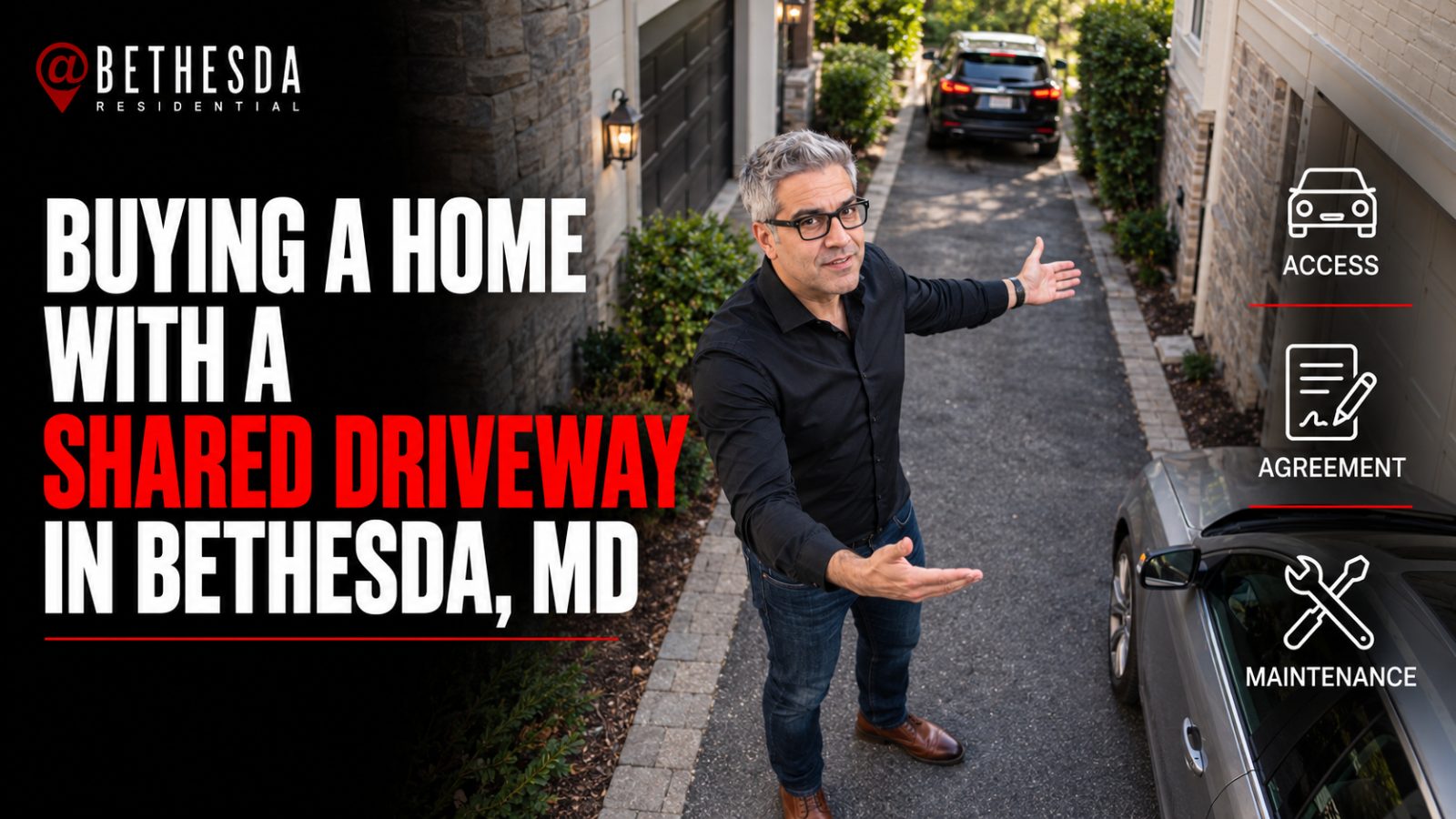
Buying a home with a shared driveway in Bethesda means two homes share one strip of pavement, so before you close, confirm a recorded easement grants legal access and a written agreement splits repair, repaving, and snow-removal costs. Most lenders require that recorded agreement — a handshake deal with the neighbor can stall your loan.
Quick Answer
Buying a home with a shared driveway in Bethesda means two homes share one strip of pavement, so before you close, confirm a recorded easement grants legal access and a written agreement splits repair, repaving, and snow-removal costs. Most lenders require that recorded agreement — a handshake deal with the neighbor can stall your loan.
A shared driveway can be an easy thing to overlook on a Saturday tour. The house shows beautifully, the yard is deep, and the driveway looks like any other — until you notice it runs right up the property line and serves the house next door, too. In close-in Montgomery County, that setup is more common than most buyers expect, and it comes with a short list of questions you want answered before you write the offer, not after you own the problem.
Buying a home with a shared driveway isn't a reason to panic, and it's rarely a dealbreaker. But it does change your due diligence. The pavement is the least of it — what matters is who has the legal right to use it, who pays when it needs work, and whether your lender will sign off. Here's how I walk buyers through it.
What a shared driveway actually means in Bethesda
A shared driveway is a single strip of pavement that two (or occasionally more) homes use to reach their garages, parking pads, or rear lots. It usually takes one of two forms:
- It straddles the property line. Half the driveway sits on your lot, half on the neighbor's, and you each cross onto the other's land to come and go.
- It sits on one lot, and the other owner has an easement to use it. The pavement belongs to one property, but a recorded easement gives the neighbor a permanent legal right to drive across it.
You'll find these all over the older, close-in neighborhoods — pockets of Bethesda, Chevy Chase, Kensington, Somerset, and Garrett Park where lots are narrow, garages sit at the rear, and some homes were built before anyone drew a tidy driveway for every house. Flag lots and alley-accessed properties often rely on shared access, too.
The key word in both setups is legal. A driveway you've "always used" is not the same as a driveway you have a recorded right to use. Shared driveways are one kind of easement you'll want to understand before buying in Maryland, and the paperwork behind them is exactly what you're checking.
What to check before buying a home with a shared driveway
Run through these in order. Most of the answers live in the public record and the seller's disclosures — you just have to go look.
- Is there a recorded easement? This is the foundation. An easement recorded in the Montgomery County land records gives each owner a permanent, enforceable right to use the driveway — one that transfers with the property and survives a sale. If access rests on a handshake between the current neighbors, you have nothing, and a future neighbor can change the rules.
- Is there a written maintenance agreement? A good one spells out how costs are split, who arranges repairs and repaving, who clears snow and ice, where cars can and can't park, what happens if someone refuses to pay, and how disputes get resolved. The best agreements are recorded and written to bind future owners, not just today's neighbors.
- Where exactly is the driveway? Order a location survey so you can see the pavement relative to the actual property line. Surveys routinely turn up a driveway that sits a foot or two off from where everyone assumed, which changes who owns what.
- What does the title turn up? A title search should surface the easement and any recorded agreement. If it doesn't, that's a flag — the right to use the driveway may never have been properly documented.
- What's the history? Ask the seller — and, if you can, the neighbor — how repairs and snow removal have actually been handled, and whether there's ever been a dispute. A driveway that's been resurfaced cooperatively twice tells you something a document can't.
If all five check out — recorded easement, written and recorded maintenance agreement, a survey that matches, a clean title, and a drama-free history — a shared driveway is genuinely a non-issue. The trouble starts where one or more of those is missing.
How lenders and title companies treat shared driveways
This is the part that catches buyers off guard, because it can affect whether your loan closes at all. Mortgage lenders want to know the home has legally secured, year-round access — and for shared access, most of them want it in writing and on record.
The agency guidelines are fairly consistent:
- Conventional (Fannie Mae): an adequate, legally enforceable maintenance agreement or covenant is required for privately maintained access, and it should be recorded in the land records. It's expected to cover who pays for repairs, what happens on default, and a term that's essentially perpetual and binds future owners.
- FHA: private streets and shared access must be protected by a permanent recorded easement and covered by a joint maintenance agreement.
- VA: a permanent recorded easement plus either HOA maintenance or a joint maintenance agreement.
Here's what that means in practice: if the home has a recorded easement and a recorded maintenance agreement, you're usually fine. If it doesn't, your lender or title company can make creating and recording one a condition of the loan. And creating one at the last minute takes your neighbor's cooperation and signature — which you can't guarantee, and which can stall a closing if you discover it the week of settlement instead of the week of your offer.
On the title side, your title company needs to see that a legal easement is in place before it can insure clean access. This is one more reason owner's title insurance matters on a shared-driveway purchase: it's your protection if a boundary or access claim surfaces after you close. Flag these questions with your lender and title company early — the day you go under contract, not the day before closing.
How to negotiate — and when to walk
Finding a gap in the paperwork doesn't mean walking away. It means you have a specific, solvable item to negotiate. Depending on what's missing, I'll typically push for one of these:
- Seller records a clean agreement before closing. If there's no recorded maintenance agreement, the strongest outcome is the seller working with the neighbor to draft and record one before settlement, so you inherit a documented arrangement rather than a question mark.
- A price or closing-cost adjustment for the risk. If the arrangement can't be cleaned up in time, the uncertainty has a cost, and that belongs in the price or in a closing-cost credit.
- Your own attorney reviews it. The title company's drafter writes a neutral document; it isn't working for you specifically. On anything with real money or a tricky boundary, it's worth having your own real estate attorney read the easement and agreement before you sign.
As for when to walk: the honest answer is that most shared-driveway situations in Bethesda are fixable, and the ones that genuinely aren't are rare. The red flags are a neighbor who refuses to cooperate on documenting access, a history of real disputes, or a lender who can't get comfortable without paperwork the other owner won't sign. If you hit all three at once, the house may be more headache than it's worth — and that's a judgment call worth making with an agent who's seen how these play out.
Shared driveways also come with a quiet resale consideration. They shrink the buyer pool a little, since some buyers skip them on sight, and an undocumented one gives the next buyer the same pause you're feeling now. The flip side: a shared driveway with a clean, recorded agreement barely registers as a negative. Getting the paperwork right doesn't just protect you — it protects your resale.
Buying a home with a shared driveway comes down to three questions: do you have the legal right to use it, is it clear who pays for what, and will your lender and title company sign off? Answer those before you're under contract and the driveway becomes a footnote. Miss them, and it can become the whole story. If you're weighing a home with shared access in Bethesda or anywhere in Montgomery County, I'm happy to pull the plat, read the easement with you, and help you decide whether it's a non-issue or a negotiating point. Reach out anytime.
About Pey Behin
Pey Behin is a residential real estate agent serving the Washington, DC metro area, with a focus on Bethesda, Montgomery County, and Northern Virginia. He works with buyers and sellers who want clear strategy, data-driven pricing, and direct guidance throughout the transaction process.