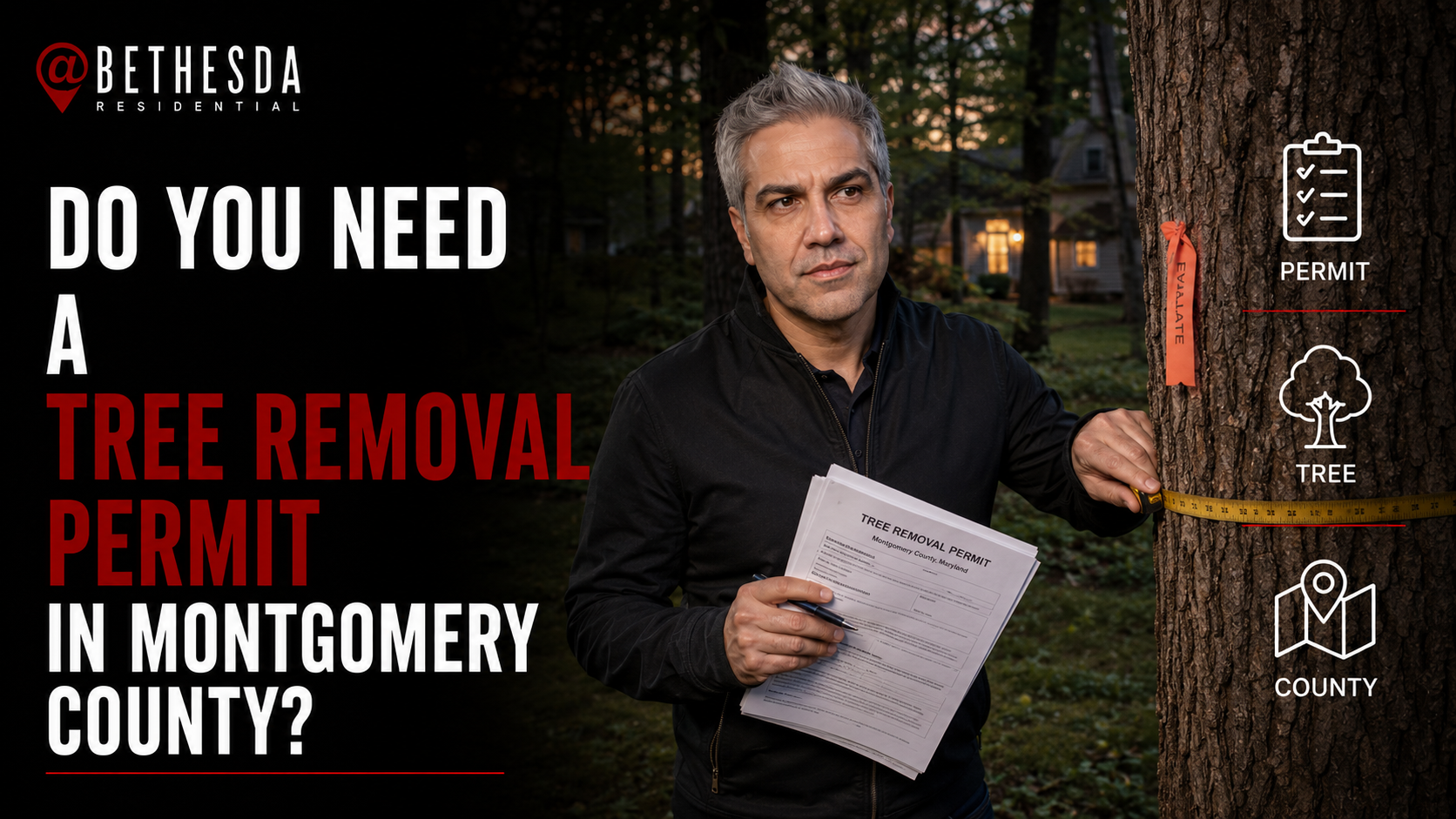
In most cases you don't need a tree removal permit in Montgomery County to remove a healthy tree on your own private lot — but you must hire a Maryland Licensed Tree Expert. Permits are required for roadside trees, trees in a conservation easement or historic area, and any work disturbing more than 5,000 square feet of soil or canopy.
Quick Answer
In most cases you don't need a tree removal permit in Montgomery County to remove a healthy tree on your own private lot — but you must hire a Maryland Licensed Tree Expert. Permits are required for roadside trees, trees in a conservation easement or historic area, and any work disturbing more than 5,000 square feet of soil or canopy.
If you're buying a teardown lot in Bethesda, eyeing a wooded property in Potomac, or getting ready to sell a home on a big lot, one question comes up fast: can you actually take down the trees you want to? In Montgomery County, the answer depends less on whose name is on the deed and more on where the tree sits and what you're doing to the property.
Here's the short version. Most healthy trees in your own private yard can come down without a county permit — but the moment a tree touches a road right-of-way, a conservation easement, a historic area, or a construction project that disturbs enough ground, the rules change quickly. Getting a tree removal permit in Montgomery County wrong can stall a settlement, blow up a renovation budget, or leave a new owner holding fines.
This is the kind of due diligence I walk buyers and sellers through before they commit, because a "great lot with room to build" isn't worth much if the county won't let you clear it.
When you don't need a tree removal permit in Montgomery County
Start with the good news. If a tree is entirely on your private property, is not in a road right-of-way, is not a protected specimen, and you're not doing construction that disturbs a large area of ground, you generally do not need a county permit to remove it.
There's one rule that still applies, though, and it trips people up: in Maryland, anyone you pay to work on a tree has to be a Maryland Licensed Tree Expert. That license means the crew is trained, insured, and bonded — which protects you if a limb comes down on your roof or your neighbor's fence. You can verify a license through the Maryland Department of Natural Resources Forest Service, and it's smart to get the estimate and scope in writing before work starts. Be wary of crews that solicit door-to-door with only a cell number.
So on a typical Bethesda or Chevy Chase lot, removing a dying oak in the backyard is usually a matter of hiring a licensed crew — not filing paperwork. The permit questions start when the tree, or your project, crosses one of the lines below.
When a tree removal permit in Montgomery County is required
Run your tree through this checklist. If you answer "yes" to any of these, you need a permit or written approval before anything comes down:
- The tree is in a road right-of-way. Any tree in the public right-of-way — including the one on the strip between the sidewalk and the street in front of your house — needs a Roadside Tree Permit from the Maryland DNR Forest Service. If the road is county-maintained, you also need a separate permit from Montgomery County's Department of Permitting Services. That's two permits for one tree.
- You're disturbing more than 5,000 square feet of soil or canopy. That triggers a sediment control permit from Permitting Services — the threshold most teardowns and large additions hit.
- Your project already needs a sediment control permit. Once that's required, you may also have to comply with the county's Forest Conservation Law and Tree Canopy Law (more on that below).
- The tree is in a conservation easement. You'll need permission from a Montgomery Planning forest conservation inspector before touching it.
- The tree is on a historic site or in a historic district. Removal may require a Historic Area Work Permit — the same layer of review that shapes what you can change when buying a home in a Montgomery County historic district.
- It's a County Champion Tree. The largest documented trees of their species get the highest protection and need Planning Department sign-off.
- You're inside an incorporated town or village. Places like the Town of Chevy Chase, Kensington, Somerset, and Takoma Park run their own tree ordinances. Takoma Park, for example, requires a permit and charges an application fee even for private trees.
- Your HOA or civic association has tree rules. Many communities do — check your covenants before you schedule a crew.
One exception cuts the other way. If a licensed tree expert determines a tree is hazardous, the dangerous portion can be removed right away — but the expert has to notify the appropriate agency in writing within 14 days, and anything beyond the immediate hazard still needs the normal permits.
The Forest Conservation Law — the one that matters for teardowns
If you're buying to renovate heavily, build an addition, or tear down and rebuild — a common play across Bethesda and Potomac right now — the Forest Conservation Law (Chapter 22A) is the rule to understand. It generally applies on properties of about 40,000 square feet or larger, when a sediment control permit is required, or when land is being subdivided.
When it applies, you can't simply clear the lot. You may need an approved forest conservation plan, and removing protected trees can require replanting on site or paying into a county conservation fund. On a wooded Potomac acre, that can mean several thousand dollars in mitigation you never budgeted for. This is exactly why lot due diligence matters before you write the offer — the same way you'd check for unpermitted work or an easement running through the yard.
What this means when you're buying
Before you fall for a lot because of its "potential," find out what you're actually allowed to do with the trees on it:
- Walk the lot and note any trees near the street — those are the ones most likely to sit in a right-of-way.
- Ask whether the property falls in a conservation easement or historic area. Title work and a survey will surface recorded easements.
- If your plan is a teardown or major addition, factor Forest Conservation Law compliance and possible mitigation into your budget before you're under contract — the rules around a tree removal permit in Montgomery County can quietly reshape a renovation budget.
- For large or heavily wooded lots, have a licensed tree expert or arborist give you a read before closing.
What this means when you're selling
If you own a wooded or oversized lot — especially the kind a builder would want — the trees are part of your home's story either way. Buyers planning to build will ask what they can clear; buyers who love the mature canopy will want to know it's protected. Either way, don't remove a right-of-way tree yourself to "clean up" before listing without the proper permits. Unauthorized removal can bring fines and mitigation costs, and in Maryland, cutting a tree that isn't yours can expose you to up to triple the tree's value in damages.
If a builder is your likely buyer, understanding the county's tree and forest rules helps you speak to what's realistic on the lot and price accordingly — something worth thinking through if you're weighing an offer from a builder for a teardown.
Trees are one of those quiet details that can make or break a Bethesda or Potomac transaction — a selling point on one lot, a five-figure surprise on the next. If you're trying to figure out what a specific property will actually let you do, I'm happy to walk you through it before you commit. Reach out anytime.
About Pey Behin
Pey Behin is a residential real estate agent serving the Washington, DC metro area, with a focus on Bethesda, Montgomery County, and Northern Virginia. He works with buyers and sellers who want clear strategy, data-driven pricing, and direct guidance throughout the transaction process.