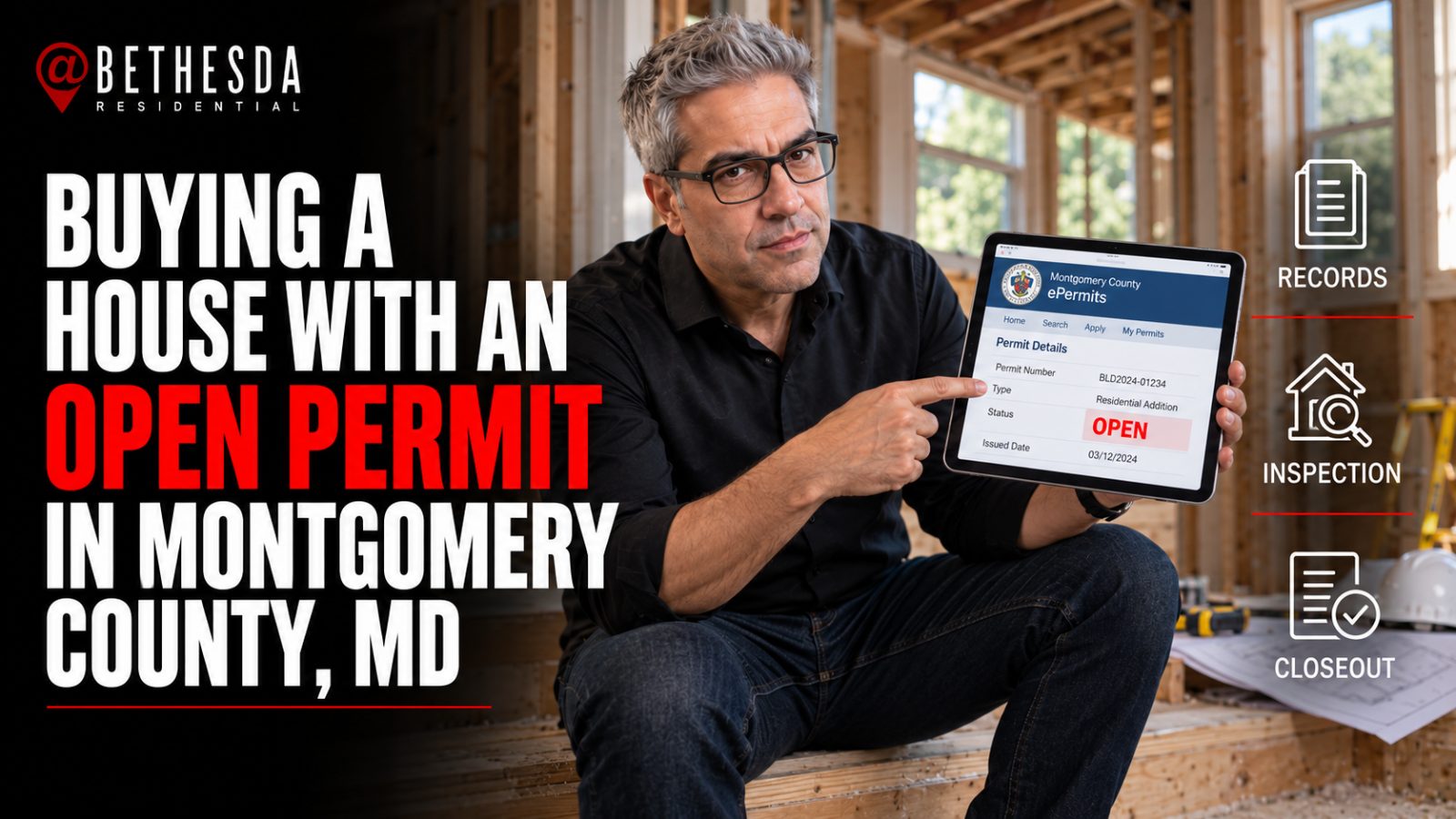
An open permit means Montgomery County issued a building permit for past work — a deck, a finished basement, an addition — but never recorded the final inspection to close it out. It shows up in your title search, isn't covered by title insurance, and can stall closing. The fix: have the seller reopen the permit, pass the DPS final inspection, and get it finaled before settlement — or negotiate a credit or escrow holdback to cover it.
Quick Answer
An open permit means Montgomery County issued a building permit for past work — a deck, a finished basement, an addition — but never recorded the final inspection to close it out. It shows up in your title search, isn't covered by title insurance, and can stall closing. The fix: have the seller reopen the permit, pass the DPS final inspection, and get it finaled before settlement — or negotiate a credit or escrow holdback to cover it.
You found the home — maybe a renovated colonial in Chevy Chase or an expanded split-level in Potomac — and then the title search comes back with a flag: there's an open permit on the property. The finished basement, the back deck, or the kitchen addition was permitted years ago, but Montgomery County never recorded a final inspection to close it out. The work looks done. On the county's records, it isn't.
Buying a house with an open permit isn't cause to panic, and it's rarely a reason to walk. But it isn't something to wave through either. Left unresolved, an open permit can slow your closing, poke a hole in your title coverage, and leave you holding a problem the previous owner created. Here's what it actually means and exactly how to clear it before you own it.
What an open permit actually is
An open permit is a building, electrical, mechanical, or plumbing permit that Montgomery County's Department of Permitting Services (DPS) issued but never signed off as complete. Someone pulled the permit, the work got done, and the required final inspection either never happened or never got recorded in the county's file.
That's a different problem from unpermitted work, where the work was done with no permit at all. With unpermitted work, the county has no record that the project ever existed. With an open permit, the county has a record — and it's sitting there unfinished, with the property address attached to it. Same neighborhood of trouble, different house.
Under Montgomery County Code §8-25, a permit becomes invalid once 12 months pass with no approved inspection recorded, and a second approved inspection isn't recorded within 14 months. Work that's suspended or abandoned for six months voids the permit too. The county allows one six-month extension if the permit holder asks in writing and pays the fee before it lapses. Here's the catch that trips up buyers: "invalid" doesn't mean "erased." The permit still shows as open in the record until someone formally finals or closes it — and that open status is exactly what you inherit when you buy.
Open permits show up constantly in older Bethesda-area homes because these houses have been renovated two and three times over. The usual culprits:
- Finished basements and basement bathrooms
- Decks, porches, and screened additions
- Kitchen and bath remodels that moved plumbing or electrical
- Replacement HVAC systems, water heaters, and electrical panels
- Additions, garage conversions, and removed load-bearing walls
A 1950s Cape Cod in Kensington or a mid-century home in Bethesda that's been updated by three different owners is a prime candidate. Each round of work is another chance for a permit to get pulled and then forgotten the moment the contractor got paid.
How to check for an open permit before buying a house in Montgomery County
Don't judge by how the work looks. A deck can be beautiful and still have an open permit behind it. Verify it on the record instead. There are two places an open permit should surface before you buy:
- The DPS permit search. Montgomery County's online portal at permittingservices.montgomerycountymd.gov lets anyone look up a property's full permit history and current status. In a few minutes you can see which permits are finaled, which are expired, and which are still open. I pull this for clients as a matter of course — ideally before we write, or at the latest right after we're under contract.
- The title search. Your title company reviews county records while preparing for closing. A thorough title search flags open permits, but not every search digs to the same depth, so it's worth confirming the permit history was actually checked rather than assuming it was.
Once you have the list, match each open permit against what you can see in the home. A permit from 2019 for a basement finish that's obviously complete but was never finaled is your textbook open permit — the work is real, the paperwork just stopped short.
Why an open permit can stall your closing
Here's the part that catches most buyers off guard: title insurance generally does not cover open permits. They're treated as a zoning and building-code matter, not a title defect, which puts them squarely in the policy's list of exclusions. If you close with an open permit and the county later requires the work to be inspected, corrected, or re-permitted, that bill lands on you — your title policy won't touch it.
An open permit can ripple into the rest of the transaction, too:
- Use and occupancy. Montgomery County ties certain sign-offs to completed, inspected work. An open permit on a major addition or a basement apartment can complicate occupancy approvals down the line.
- Your lender and appraiser. Lenders and appraisers want to see that visible, permitted improvements are complete and safe. Incomplete or clearly unsafe work can give an underwriter pause — the specifics depend entirely on your loan and your lender, so have that conversation early rather than guessing at it.
- Your own resale. The open permit doesn't vanish because you ignored it. Whoever you sell to someday will run the same search and ask the same questions — except now it's your problem to explain.
None of this makes the home unbuyable. What it does is turn the open permit into something you resolve on paper before you own it, rather than a surprise you discover after the keys are yours.
How to clear an open permit before closing
The cleanest outcome is the simplest one: the seller closes the permit out before you reach the settlement table. In practice that means:
- Reopening or reinstating the permit with DPS — a long-lapsed permit may need reinstatement or, in some cases, a fresh permit.
- Scheduling the final inspection through DPS eServices or by calling MC311 at 240-777-0311.
- Correcting anything the inspector flags, then getting that final approval recorded in the county file.
When the work was actually done to code, the cost is usually modest. A reinspection fee runs about $104.91, and an inspection tied to previously unpermitted work is roughly $162.22 as of 2026. Work done with no permit at all can carry a penalty of around 15% of the permit fee. The number only gets painful if an inspector opens things up and finds something that has to be torn out and redone — which is exactly why you want this handled before, not after, you buy.
If the seller can't or won't finish the close-out before settlement, you still have good options — and this is where having an agent in your corner earns its keep:
- Negotiate a credit or price reduction. Treat the close-out like any other repair issue and negotiate a closing credit to cover the cost and the hassle.
- Use an escrow holdback. Money can be held back at closing through an escrow holdback and released once the permit is finaled, so the seller stays on the hook until the job is actually closed.
- Make it a condition of the contract. Build finaling the permit into your purchase agreement so settlement doesn't happen until the record is clean.
Selling instead of buying? Pull your own permit history before you list. Finding an open permit on your own schedule — and quietly closing it out — beats having a buyer's title company surface it mid-deal, when the clock is running and the leverage has shifted to the other side of the table.
An open permit is a paperwork problem, not a dealbreaker — as long as you catch it, price it, and clear it before you own the house. The buyers who get burned are the ones who assumed "it looks finished" meant "it's finished on the record." In Montgomery County, those are two very different things.
If you're weighing a Bethesda-area home with an open permit on the books, I'm happy to pull the permit history, read through the title work, and map out exactly what it'll take to clear it. Reach out anytime.
About Pey Behin
Pey Behin is a residential real estate agent serving the Washington, DC metro area, with a focus on Bethesda, Montgomery County, and Northern Virginia. He works with buyers and sellers who want clear strategy, data-driven pricing, and direct guidance throughout the transaction process.