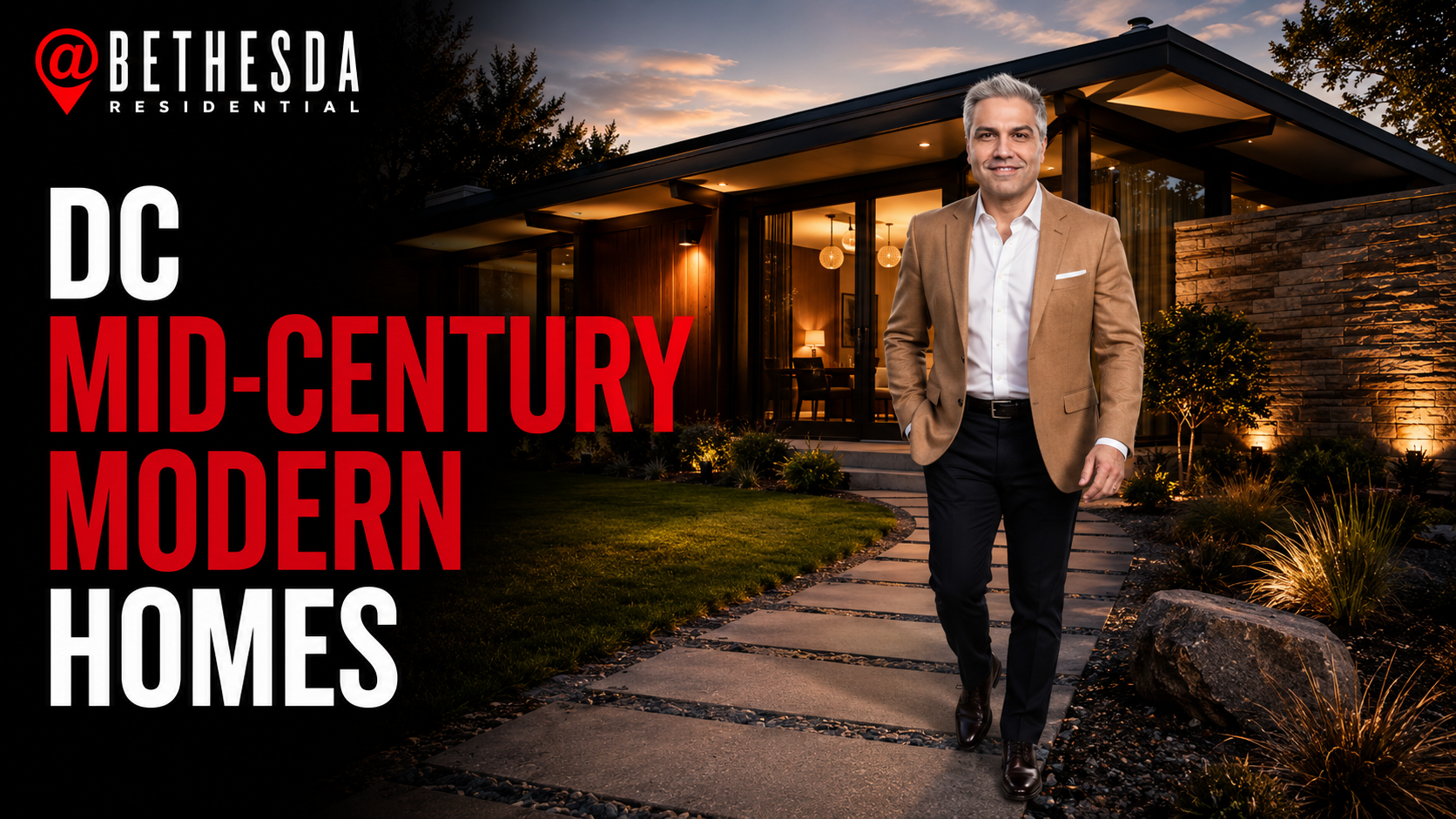
Mid-century modern homes are 1945–1970 houses defined by open floor plans, flat or low-slope roofs, walls of glass, and a seamless connection to nature. The DC metro has some of the country's best examples — Carderock Springs, Hammond Wood, Rock Creek Woods, Hollin Hills — many by architect Charles M. Goodman. Work with an agent who knows these neighborhoods and how mid-century modern homes are valued, inspected, and preserved.
Quick Answer
Mid-century modern homes are 1945–1970 houses defined by open floor plans, flat or low-slope roofs, walls of glass, and a seamless connection to nature. The DC metro has some of the country's best examples — Carderock Springs, Hammond Wood, Rock Creek Woods, Hollin Hills — many by architect Charles M. Goodman. Work with an agent who knows these neighborhoods and how mid-century modern homes are valued, inspected, and preserved.
If you love clean horizontal lines, walls of glass, and a house that feels like it grew out of the woods around it, you're drawn to one of the most collectible styles in American real estate. And here's the good news: the Washington, DC metro is one of the best places in the country to own one.
Mid-century modern homes aren't just a look — they're a specific era, a design philosophy, and in this region, a handful of remarkable neighborhoods that buyers seek out by name. This guide covers what defines the style, where to find the best examples around Bethesda and the wider DC metro, why our area has such a rich concentration of them, and what you need to know before you buy or sell one.
What Are Mid-Century Modern Homes?
Mid-century modern homes are houses built roughly between 1945 and 1970 that share a clear design language: form follows function, and the house connects to the landscape rather than hiding from it.
The hallmarks are easy to spot once you know them:
- Flat, low-slope, or butterfly roofs with wide overhangs and exposed beams
- Post-and-beam construction that frees up the floor plan from load-bearing walls
- Floor-to-ceiling glass and clerestory windows that pull daylight deep into the home
- Open, flowing layouts that blur the line between kitchen, living, and dining space
- Seamless indoor-outdoor living — sliding glass doors, patios, and homes sited to follow the natural terrain
- Honest materials like brick, stained wood, and stone, often with a sculptural chimney as the anchor
The philosophy behind mid-century modern homes was democratic: bring good design, light, and a connection to nature to ordinary families, not just the wealthy. That ethos is exactly why so many of these homes were built in postwar suburbs — including ours.
It's also worth knowing the difference between authentic mid-century modern homes and the "midmod-inspired" new construction you'll see marketed today. A true mid-century home was designed in the period by an architect working in the idiom, on a lot chosen to suit the house. A new build borrowing the aesthetic can be lovely, but it won't carry the same provenance, craftsmanship, or — often — the same long-term demand. Knowing which one you're looking at is the first step to buying well.
Where to Find Mid-Century Modern Homes in the DC Metro
Most of the region's mid-century modern homes are clustered in intact, architect-designed neighborhoods. If you're shopping in this style, you're really shopping these communities by name. Several of the very best sit right in Montgomery County.
Carderock Springs (Bethesda). Roughly 275 modern homes built between 1962 and 1966 by developer Edmund Bennett with the noted firm Keyes, Lethbridge & Condon. Set on gently sloping half-acre lots along winding, wooded streets, Carderock Springs is a textbook example of "situated modernism" — cathedral ceilings, glass walls, and indoor-outdoor flow. It's a designated historic district, which shapes how homes can be altered.
Hammond Wood (Kensington / Wheaton). A small, beautifully preserved enclave of 58 homes built from 1949 to 1951 and designed by Charles M. Goodman, the architect most associated with DC-area modernism. Angled siting for privacy and solar gain, expansive glass, and brick facades define the street.
Rock Creek Woods (Silver Spring). Just 76 Goodman-designed homes built from 1958 to 1961 across about 28 acres of curving streets and rolling terrain.
New Mark Commons (Rockville). A larger planned community from the same Bennett and Keyes, Lethbridge & Condon team behind Carderock Springs, organized around a lake and shared open space.
Across the river, Northern Virginia adds two more icons: Hollin Hills in Alexandria — about 450 Goodman-designed homes with flat roofs and glass walls set into wooded valleys, now a national historic district — and Holmes Run Acres in Falls Church, one of the area's earliest and largest modern subdivisions with roughly 355 homes built in the 1950s.
Why the DC Metro Has Some of the Best Mid-Century Modern Homes
Our region's collection isn't an accident. After World War II, the federal workforce exploded and demand for housing surged across the suburbs. That timing put the building boom squarely in the mid-century modern era.
Two ingredients made the difference here. First, visionary developers like Edmund Bennett were willing to bet on modern design at scale. Second, they hired serious architects — above all Charles M. Goodman, plus firms like Keyes, Lethbridge & Condon — who knew how to set a house into a wooded hillside instead of bulldozing it flat.
The rolling, tree-covered terrain of Montgomery County and Northern Virginia was perfect for that approach. The result is a region with an unusually high number of complete, well-preserved mid-century modern neighborhoods — many now protected as historic districts, which keeps the architecture intact and the demand strong. For buyers who want the real thing rather than a builder's reinterpretation, few metro areas offer this much to choose from. It's one of the reasons the area remains a strong place to buy real estate, and why design-driven buyers keep circling these specific streets.
What to Know Before Buying a Mid-Century Modern Home
These homes are wonderful to live in, but they were built for a different era of energy codes and materials. Going in informed protects both your enjoyment and your investment.
- Single-pane windows. Original glass in thin aluminum or steel frames has an R-value near 1.0 — almost no insulation. The good news: specialty glaziers now make double-pane glass that preserves the original sightlines, so you can upgrade comfort without ruining the look.
- Flat and low-slope roofs. They're part of the style's beauty, but they need more attentive maintenance and can carry higher repair and insurance costs. Budget for it and get the roof evaluated closely.
- Original systems. Electrical, plumbing, and HVAC are sometimes close to original. Plan to assess and update these before chasing cosmetic projects.
- Older-home hazards. Asbestos was common in materials from the 1940s through 1980, and these homes are old enough that a thorough inspection matters. Because much of this housing stock sits in wooded Montgomery County, radon testing is worth doing too.
- Historic district rules. Neighborhoods like Carderock Springs and Hammond Wood have design guidelines or review boards governing exterior changes, materials, and additions. That oversight protects your home's value — but you'll want to understand the rules before you plan a renovation.
A piece of advice I give every mid-century buyer: live in the home for a season before making big interior changes. These houses were designed as a complete idea, and the original details — paneling, built-ins, terrazzo, tile — are often irreplaceable. You'll also want to factor the usual buyer closing costs into your budget alongside any planned updates.
This is exactly where working with an agent who actually knows these neighborhoods pays off. Pricing a Goodman in Hammond Wood, reading a historic-district covenant, or spotting a sympathetic window replacement from a regrettable one takes specific local knowledge — not a generic comp pull.
If you're hunting for the right mid-century modern home in Bethesda, Montgomery County, or anywhere in the DC metro — or you own one and want to sell it to a buyer who'll value it — I'd love to help. Reach out anytime and let's talk about what you're looking for.
About Pey Behin
Pey Behin is a residential real estate agent serving the Washington, DC metro area, with a focus on Bethesda, Montgomery County, and Northern Virginia. He works with buyers and sellers who want clear strategy, data-driven pricing, and direct guidance throughout the transaction process.