In Maryland, how title is held determines who inherits the property if a co-owner dies, whether creditors can reach your home, and whether one owner can sell without the other's consent. Married couples automatically hold title as tenants by the entirety — the strongest form — while unmarried co-buyers default to tenants in common.
Quick Answer
In Maryland, how title is held determines who inherits the property if a co-owner dies, whether creditors can reach your home, and whether one owner can sell without the other's consent. Married couples automatically hold title as tenants by the entirety — the strongest form — while unmarried co-buyers default to tenants in common.
At closing, when the title attorney hands you the deed to sign, they'll ask: "How do you want to hold title?" If you've never thought about this before, you'll be tempted to just nod and let them fill it in. Don't.
How title is held in Maryland shapes three things that matter far more than most buyers realize: who inherits your share if you die, whether your co-owner can sell the property without your consent, and whether a creditor can reach your home to satisfy a debt. Getting this right takes about five minutes of thought — but most buyers never have that conversation before they're sitting at the settlement table.
Here's what you need to know about each option.
How Title Is Held in Maryland: Why the Decision Matters
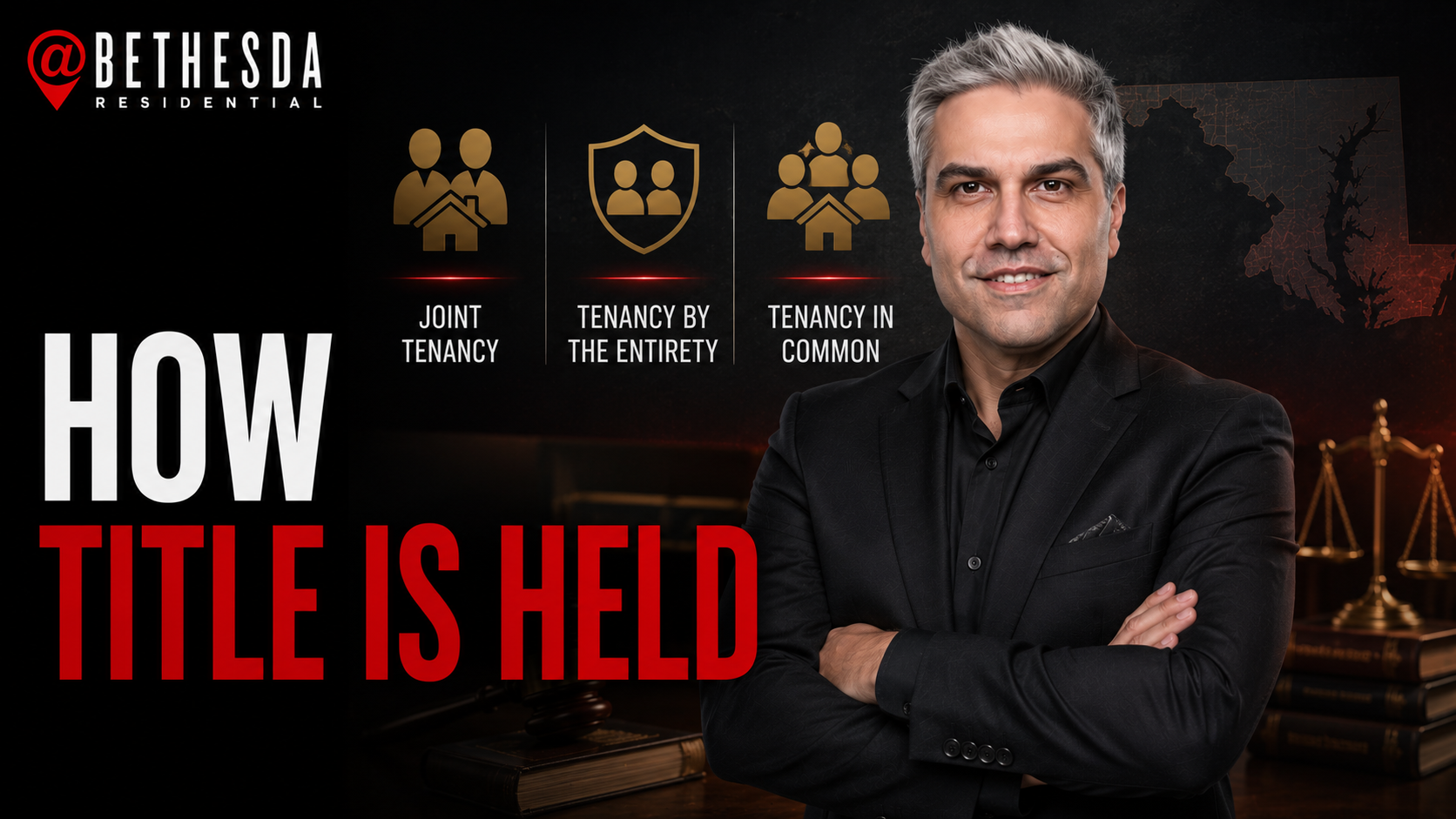
Maryland recognizes three ways to co-own real property: tenancy by the entirety, joint tenancy with right of survivorship, and tenancy in common. Which one applies to you depends on your relationship with your co-buyer — and Maryland law has strong default rules that determine what you get if you don't specify.
The choice is made at closing, when you sign the deed. Once the deed is recorded, changing your vesting requires a new deed — more paperwork, more title fees, and more complexity. It's worth making the right call before you get there. As you prepare for what to expect at closing as a Maryland buyer, this is one of the most important decisions to think through in advance.
The title company handles the mechanics, but they won't tell you which option fits your situation. That's a legal and financial decision that belongs to you.
Tenancy by the Entirety: The Default for Married Couples in Maryland
If you're married, Maryland law presumes you hold property as tenants by the entirety. You don't have to request it — it's the automatic default when a married couple buys together. Under Maryland Real Property § 4-108, that presumption is strong, and it's there for good reasons.
What tenancy by the entirety means: Unlike the other forms of ownership, TbyE treats the married couple as a single legal unit. There are no separate individual shares — you and your spouse share one unified interest in the property. Neither of you can sell, transfer, or encumber the home without the other's consent.
Right of survivorship: When one spouse dies, the surviving spouse automatically owns the entire property — no probate, no court process, no waiting. The home doesn't pass through a will or an estate. Ownership transfers by operation of law the moment of death. For a $1.2M–$2M Bethesda or Potomac home, that's a meaningful simplification of what would otherwise be an expensive and time-consuming estate administration.
Creditor protection — the feature most buyers don't know about: A creditor of only one spouse generally cannot attach, lien, or force the sale of a home held as tenants by the entirety. If your spouse has a judgment against them — a business debt, a lawsuit, a medical bill — that creditor cannot reach your shared home as long as it's held as TbyE and the debt is solely your spouse's.
This protection has real limits. It doesn't apply to joint debts — if you both signed on a loan or a credit card and default, the creditor can pursue the property. Federal tax liens operate differently from Maryland private-creditor law and may reach TbyE property in ways that ordinary creditors cannot. And transfers made to evade creditors can be challenged under Maryland's fraudulent conveyance statute. But for most married buyers in Bethesda, Chevy Chase, or North Bethesda, the protection is substantial.
What happens at divorce: Divorce automatically converts tenancy by the entirety to tenancy in common under Maryland law. The unified ownership splits into two separate, equal shares — and creditor protection disappears. If you divorced and still co-own property in Montgomery County, your ownership structure is now tenancy in common regardless of how the original deed was titled.
When married couples might choose a different form: A few situations warrant a conversation with an estate planning attorney before closing. If one spouse contributed significantly more equity and wants that reflected legally, TbyE doesn't allow unequal shares. If one spouse has children from a prior relationship and wants to leave their portion to those children rather than their current spouse, TbyE won't accomplish that — the survivor inherits automatically. In those cases, tenancy in common with a carefully drafted will or trust may better reflect what the couple actually wants.
Tenancy in Common and Joint Tenancy: Options for Unmarried Co-Buyers
If you're buying with someone you're not married to — a partner, a sibling, a parent, a friend — tenancy by the entirety isn't available. Maryland defaults to tenancy in common for unmarried co-buyers, and you have to expressly request joint tenancy if that's what you want.
Tenancy in Common (the unmarried default):
- Each owner holds a separate, individual share — and shares can be unequal (60/40, 75/25, or any split the parties agree on)
- No right of survivorship: when one owner dies, their share passes to their estate and heirs, not automatically to the surviving co-owner
- Each owner's share is subject to their own creditors — a judgment against one co-owner can attach to their fractional interest
- Each owner can transfer or sell their share independently, though the buyer of that share becomes your new co-owner
- A co-owner who wants out can pursue a partition action in court to force a sale if you can't agree on a buyout
Tenancy in common makes sense for investment partners with unequal contributions, or for co-buyers who have separate estate plans and want to leave their share to their own heirs. The flexibility on ownership percentages and the ability to will your share to whoever you choose are its main advantages.
Joint Tenancy with Right of Survivorship (must be expressly requested):
- Maryland presumes against joint tenancy — the deed must explicitly say "as joint tenants with right of survivorship" or it defaults to tenancy in common
- Both owners must acquire their interests at the same time, through the same deed, in equal shares
- Right of survivorship: the surviving owner inherits the deceased's share automatically, without probate
- No creditor protection comparable to TbyE: each owner's individual share can be reached by their own creditors
- If one joint tenant transfers or sells their share to a third party, the joint tenancy is severed and converts to tenancy in common
- Divorce does not automatically sever joint tenancy in Maryland — unlike tenancy by the entirety
Joint tenancy makes sense for unmarried co-buyers who want survivorship rights — when one of you dies, the other inherits seamlessly without probate. Long-term unmarried partners often prefer this over tenancy in common for that reason. The tradeoff: your share remains exposed to your own creditors, and you don't have the unilateral protection a married couple has under TbyE.
One practical note: if you're an unmarried buyer and you want joint tenancy, you need to say so when you review the deed. It won't happen automatically. Your closing attorney or title company will ask how you want to hold title — that's your moment to confirm.
For a full picture of what else you'll encounter at the settlement table, see our guide on what to expect at closing as a Maryland buyer. And if you're sorting out the cost side of closing — title fees, transfer taxes, and other line items — our guide to buyer closing costs in Bethesda covers the full breakdown. Note that title insurance is a separate closing cost from your vesting decision — it protects against title defects, not co-ownership disputes.
The bottom line: how you hold title in Maryland is a decision worth making intentionally, not defaulting into. Married? Tenancy by the entirety is almost always the right call, but review it in the context of your estate plan. Unmarried co-buyers? Decide whether survivorship or ownership flexibility matters more, and make sure your deed reflects it before you sign.
If you're working through this for an upcoming purchase in Bethesda, Potomac, Chevy Chase, North Bethesda, or anywhere in Montgomery County, I'm happy to walk through the considerations with you before you get to the closing table. Reach out anytime.