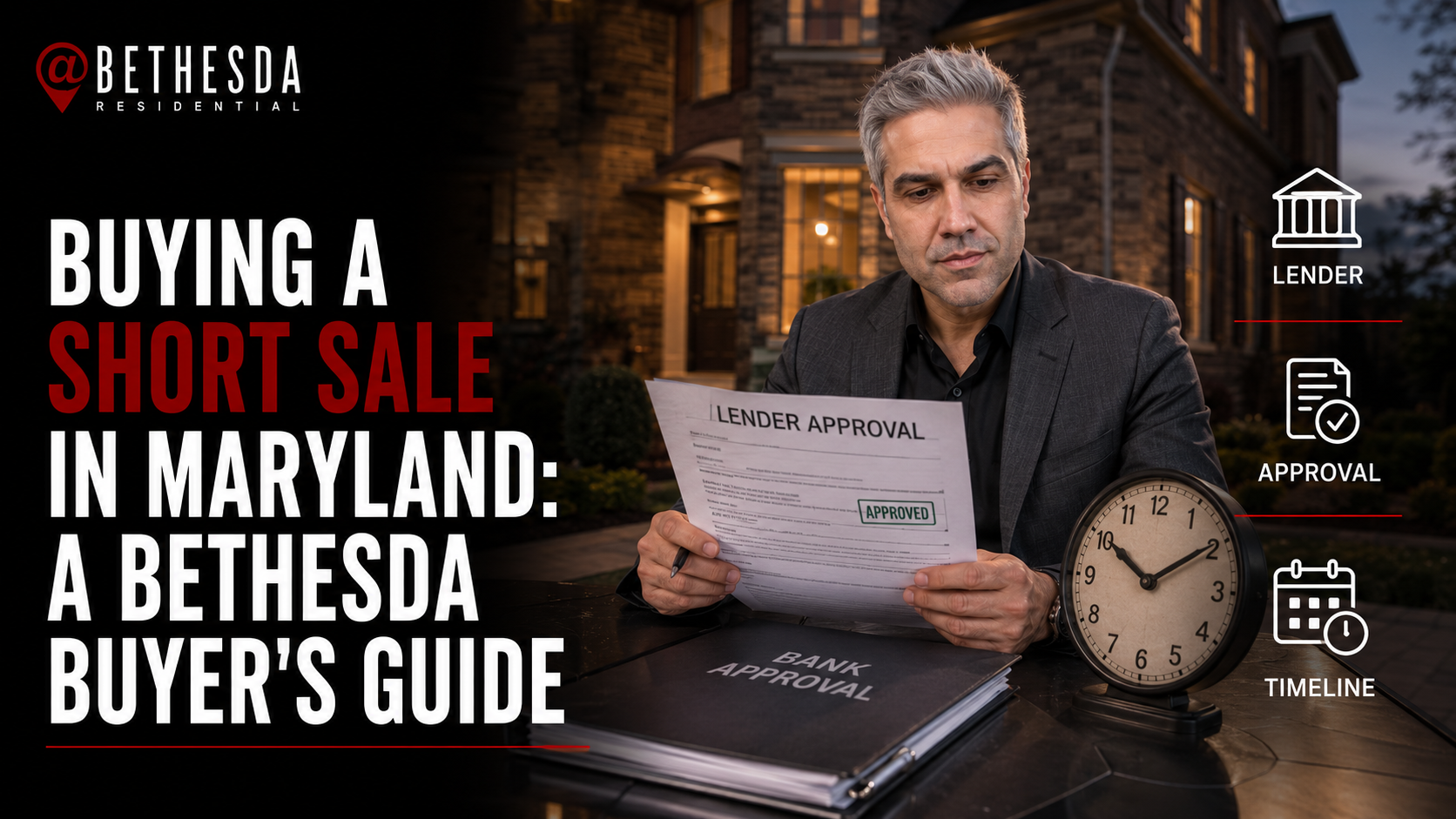
Buying a short sale in Maryland means purchasing a home for less than the seller owes, with the seller's mortgage lender approving the loss. Expect a three-to-nine-month timeline and an as-is sale. One Maryland quirk trips up most buyers: real estate agents can't legally negotiate the short sale with the lender — only the seller, a certified provider, or a Maryland attorney can. In high-equity markets like Bethesda and Potomac, true short sales are rare, so confirm the listing really is one before you commit.
Quick Answer
Buying a short sale in Maryland means purchasing a home for less than the seller owes, with the seller's mortgage lender approving the loss. Expect a three-to-nine-month timeline and an as-is sale. One Maryland quirk trips up most buyers: real estate agents can't legally negotiate the short sale with the lender — only the seller, a certified provider, or a Maryland attorney can. In high-equity markets like Bethesda and Potomac, true short sales are rare, so confirm the listing really is one before you commit.
You found a Bethesda listing priced well under everything around it, and the words "short sale" are sitting in the remarks. Before you get attached to that number, you need to understand what you're actually stepping into.
Buying a short sale in Maryland is not the same as scoring a quick, easy deal. It's a slower, lender-controlled process with a few rules specific to this state — and one of them catches almost every buyer off guard. Here's how it really works, and how to decide whether it's worth your time.
What buying a short sale in Maryland actually means
A short sale happens when a homeowner owes more on the mortgage than the home is worth and needs to sell anyway. Because the sale price won't cover the loan balance, the seller's lender has to agree to accept less than it's owed. That approval — not the seller's signature — is what makes or breaks the deal.
So when you make an offer on a short sale, you're really making two offers at once: one to the seller, and one to a bank that isn't in the room. The seller can accept your price in a day. The lender can take months to weigh in, and it's under no obligation to say yes at all.
That's the core idea to hold onto. In a normal Bethesda transaction, a ratified contract means you're moving forward toward closing. In a short sale, a signed contract is just the starting line — the real waiting begins after everyone agrees.
Short sale vs. foreclosure — why the difference matters to you
Buyers often lump short sales and foreclosures together. They're different animals, and the difference changes what you're buying.
A short sale is voluntary. The owner still holds title and, in most cases, still lives in the home, so the property tends to be in better shape and better maintained. A foreclosure is involuntary — the lender has taken, or is taking, ownership, and those homes are more often sold in rougher condition after sitting empty. If you're weighing both paths, our guide to buying a foreclosure in Maryland breaks down that side of the market in detail.
The tradeoff comes down to condition versus speed. Short sales usually arrive in better shape but move far more slowly. Foreclosures can close faster but carry more repair risk. Neither is automatically the smarter buy — it depends on your timeline, your budget for repairs, and how much uncertainty you can stomach while your money sits committed.
The Maryland rule that surprises almost every buyer
Here's the part most buyers don't see coming. In Maryland, your real estate agent — and the seller's agent — cannot legally negotiate the short sale with the lender.
Under Maryland's Mortgage Assistance Relief Services (MARS) rules and Maryland Real Estate Commission guidance, negotiating a reduced payoff with a mortgage servicer falls outside the scope of a real estate license. That work has to be handled by the seller directly, by a certified MARS provider, or by a Maryland real estate attorney practicing law. It's a consumer-protection rule, and it's stricter here than in many other states.
Why does this matter to you as the buyer? Because the skill of whoever is handling that lender negotiation largely determines whether your deal closes in three months or drags out past nine. A seasoned negotiator assembles a complete package the first time; an inexperienced one triggers rounds of missing-document requests that stall everything.
Before you commit, ask the listing agent a direct question: who is negotiating this short sale with the lender, and have they done it before? If the answer is vague or you sense nobody experienced is steering it, treat that as a yellow flag on the whole transaction.
What the timeline really looks like
A standard Bethesda sale can go from ratified contract to closing in roughly 30 to 45 days. A short sale plays by very different math, largely because of the paperwork the lender demands. A short sale package often runs well over 100 pages — the contract, a preliminary settlement statement, a market analysis of the property, and the seller's full financial and hardship documentation.
Here's a realistic breakdown of the wait:
- Lender review of the seller's hardship package often takes 30 to 90 days just to begin in earnest.
- Negotiating the actual payoff amount can add another 60 to 90 days on top of that.
- From accepted offer to closing, three to nine months is typical — and longer isn't rare.
Your earnest money can sit tied up for that entire stretch. And if you're financing, a long delay can outlast your rate lock. If rates move against you while you wait, your monthly payment — and even how much you qualify for — can shift under your feet. It's worth understanding how locking your mortgage rate works before you go under contract on a timeline you don't control.
The encouraging news: roughly nine out of ten homes that reach the market as short sales do eventually make it to settlement. Patience is the real price of admission here, but the deal usually does close for buyers who can wait it out.
What to check before you write an offer
If you're serious about buying a short sale in Maryland, protect yourself before you sign anything:
- Confirm it's truly a short sale. In high-equity areas like Bethesda, Potomac, and Chevy Chase, most owners hold real equity, so genuine short sales are uncommon. Some listings use the term loosely or as a marketing hook. Verify the seller actually owes more than the asking price before you invest months.
- Ask about a second loan. Find out whether there's a second mortgage or a HELOC on the property. A second lienholder means a second approval — and another layer of delay and negotiation.
- Get your own inspection. Short sales are almost always sold as-is, which means the lender won't authorize repairs. You can still inspect for information, and you'll want a clear picture of what you're taking on.
- Understand your earnest money exposure. Know exactly how and when your earnest money deposit is refundable if the lender ultimately says no.
- Line up flexible financing. Your appraisal still has to support the price for your loan, and your lender needs to be comfortable with an open-ended closing date.
This is exactly the kind of transaction where local guidance pays for itself. The listings look like bargains on paper — the real question is always whether the specific deal in front of you is worth the wait, and whether the people running the negotiation can actually get it across the finish line.
So should you pursue one?
A short sale can genuinely work in your favor if you have a flexible timeline, patience for paperwork, and no hard deadline to move by. It works against you if you're on a tight relocation clock, if your rate lock is short, or if you'll lose sleep with your earnest money committed for half a year.
The homes are real, the discounts can be real, and — just as importantly — the delays are real too. Going in with clear eyes about all three is what separates buyers who win with short sales from the ones who burn six months and walk away empty-handed.
If you've found a short sale in Bethesda or the surrounding Montgomery County market and want a straight read on whether it's worth pursuing, I'm happy to walk you through it. Reach out anytime.
About Pey Behin
Pey Behin is a residential real estate agent serving the Washington, DC metro area, with a focus on Bethesda, Montgomery County, and Northern Virginia. He works with buyers and sellers who want clear strategy, data-driven pricing, and direct guidance throughout the transaction process.