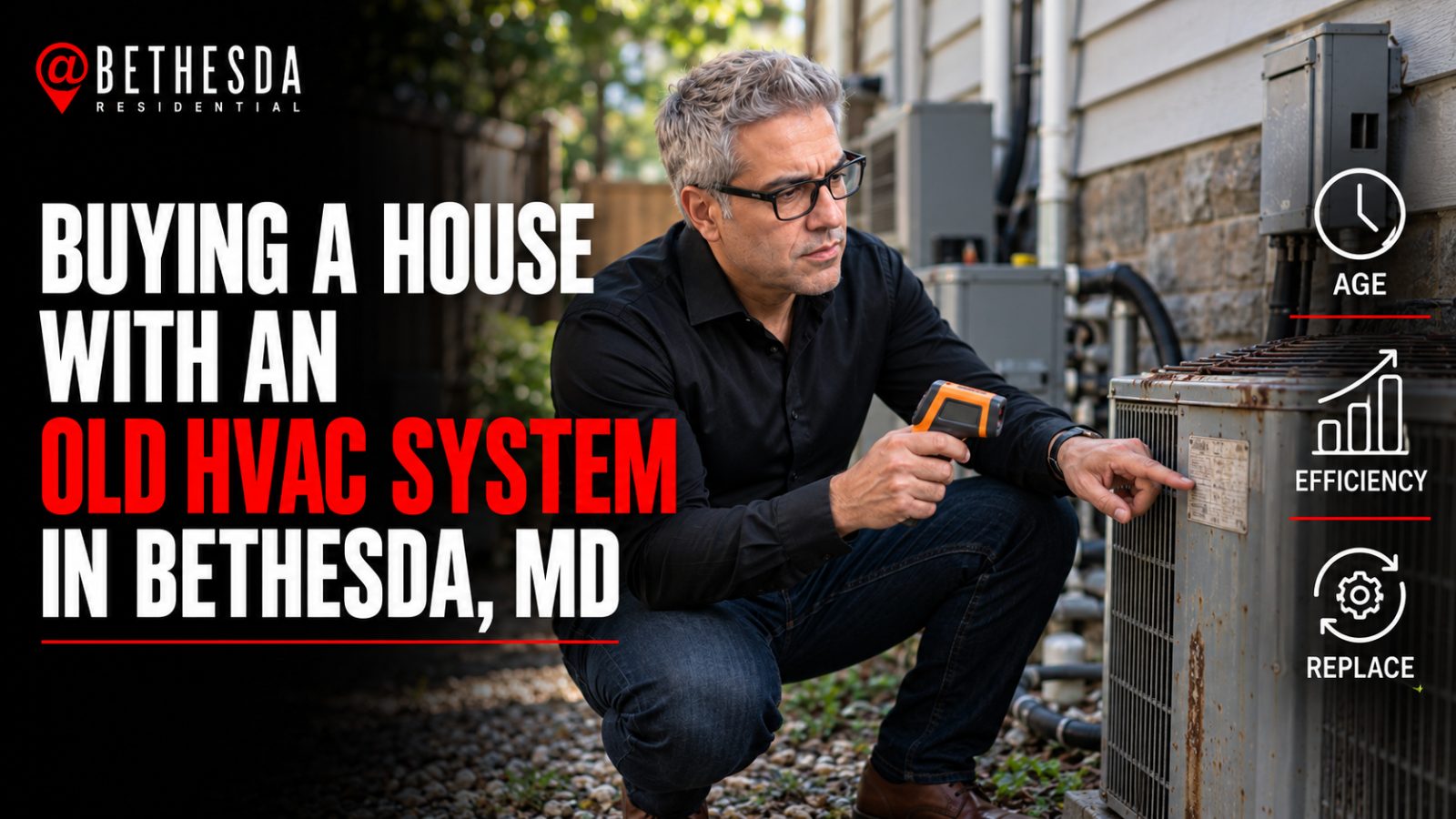
Buying a house with an old HVAC system usually isn't a dealbreaker -- it's a cost to plan for. A full furnace-and-AC replacement in the Bethesda area runs about $8,000 to $22,500, and most furnaces last 15-20 years while central AC lasts 10-15. If it's near the end, negotiate a price cut, seller credit, or holdback.
Quick Answer
Buying a house with an old HVAC system usually isn't a dealbreaker -- it's a cost to plan for. A full furnace-and-AC replacement in the Bethesda area runs about $8,000 to $22,500, and most furnaces last 15-20 years while central AC lasts 10-15. If it's near the end, negotiate a price cut, seller credit, or holdback.
If you're shopping for a home in Bethesda, Chevy Chase, Kensington, or Potomac, there's a good chance you'll fall for a house with a furnace or air conditioner older than some of the people touring it. Much of this area's housing stock dates to the 1920s through the 1980s — colonials, Cape Cods, split-levels, and ramblers — and the mechanical systems inside them don't always get replaced on schedule.
Here's the reassuring part: buying a house with an old HVAC system is rarely a dealbreaker. It's a number you plan for and a lever you negotiate with. The trick is knowing how close the system is to the end, what a replacement actually costs in this market, and how to get the seller to share the cost before you own it.
How old is too old for an HVAC system?
Every system is different, but here's what the equipment typically gives you:
- Gas furnace: 15–20 years
- Central air conditioner: 10–15 years
- Heat pump: 10–15 years — often on the shorter end, because it runs for both heating and cooling
- Boiler (older radiator homes): 15–30 years
You can usually find the age on the manufacturer's data plate — look for a build date, or decode the serial number, which your inspector or an HVAC tech can do in seconds. Then ask the seller for service records. A system that's been maintained every year will outlast one that's been ignored, even at the same age.
One local flag worth knowing: if the central AC was installed before roughly 2010, it may run on R-22 refrigerant, which has been phased out. Recharging an R-22 system after a leak is expensive now and getting worse, so an old AC on R-22 is a stronger candidate for replacement than its age alone suggests. In some older homes you'll also find heating that was converted from oil — if you see signs of that, check for an old oil tank on the property while you're at it.
What it costs to replace an HVAC system in Bethesda, MD
Replacement cost is the number that should drive your decision. Here's what you're looking at in the DC metro and Montgomery County in 2026:
- Full system (furnace + AC): about $8,000–$14,000, and up to roughly $22,500 when new ductwork is part of the job
- Gas furnace only: $3,500–$6,000
- Central AC only: $5,000–$8,000
- Heat pump (3-ton, Bethesda): $8,500–$11,500
- Ductwork: $1,500–$3,000 to seal and insulate, or $4,000–$8,000 for a full replacement
Efficiency moves the price. Maryland's federal minimum is SEER2 14.3, but most homeowners here land on a SEER2 16–18 unit for a better balance of upfront cost and energy savings. One change worth knowing: the federal 25C tax credit that used to knock up to $2,000 off a high-efficiency heat pump expired at the end of 2025. Maryland utility programs through EmPOWER (Pepco or Potomac Edison) and income-qualified rebates may still help — ask your installer what's current before you assume anything.
Don't forget the paperwork. In Montgomery County, replacing the heating system requires a permit from the Department of Permitting Services, which a licensed Maryland HVAC contractor pulls, followed by a county inspection. If the home sits in a historic district — parts of Chevy Chase, Kensington, Garrett Park, and Takoma Park — swapping out an exterior condenser can also need a Historic Area Work Permit. A legitimate contractor builds all of this into the quote.
What to check before buying a house with an old HVAC system
Your general home inspection will turn the system on, check that it heats and cools, and note the age and obvious problems. But a standard inspection is visual and operational — it's not a teardown. When the system is clearly near the end, spend the extra $100–$200 to bring in a licensed HVAC technician during your inspection contingency for a dedicated look.
Here's what moves an old system from "fine for now" to "plan to replace soon":
- A furnace past 15 years or an AC past 12
- R-22 refrigerant in the air conditioner
- Rust, corrosion, or water staining around the unit
- A cracked heat exchanger — a safety issue, because it can leak carbon monoxide
- Rooms that never heat or cool evenly
- A pattern of repair invoices, or no maintenance records at all
- A furnace and AC of very different ages, which often signals a second replacement is coming soon
Will an old system hurt your financing? Usually not. FHA and VA appraisals require a safe, functional, permanent heat source that keeps the home comfortable — an old furnace that works and passes a safety check generally clears that bar, and neither loan requires air conditioning at all. What stalls a deal is a system that's non-functional or unsafe: a red-tagged furnace, a cracked heat exchanger, no working heat source. If that's the situation, talk to your lender early, because the fix may need to happen before closing.
Insurance is the other piece buyers forget. Your homeowners insurance covers sudden damage, not the slow wear-out that ends an HVAC system's life — so a 20-year-old furnace dying in January is on you, not the carrier. A one-year home warranty, which you can often ask the seller to cover, is the product that fills that gap for mechanical breakdowns in your first year of ownership.
How to negotiate when the HVAC is near the end
This is where having an agent actually pays for itself. Once the inspection confirms the system is on borrowed time, you have real leverage — and in Maryland, where many sellers sell on an as-is disclaimer, your inspection contingency is the window where that leverage lives. Move fast: get one or two replacement quotes while the contingency clock is running so you're negotiating with a real number, not a guess.
Your options, roughly from simplest to most protective:
- Price reduction — knock the replacement cost, or a share of it, off the purchase price
- Seller credit — the seller credits you at closing toward your own replacement, so you pick the contractor and the equipment
- Seller replaces before closing — spell out the brand, efficiency, and permit in the contract so you're not handed the cheapest possible swap
- Escrow holdback — money is set aside at closing to cover the work right after
- Home warranty — the lightest option, covering breakdowns for year one rather than funding a full replacement
Which one fits depends on the house, how much competition there is for it, and how the seller is positioned. I walk clients through how to negotiate after the home inspection on every deal, and an aging HVAC system is one of the most common and most winnable items on the list. If you want the cleanest protection, an escrow holdback keeps the seller on the hook until the work is done — just make sure the structure is written correctly into the contract.
The bottom line on buying a house with an old HVAC system: it should change your offer, not your decision. Price the replacement, confirm the condition, and build the cost into how you negotiate — and a house you love with a tired furnace can still be a smart buy.
If you're weighing an offer on an older Bethesda or Montgomery County home and trying to figure out what the HVAC really means for your bottom line, I'm happy to walk you through the numbers and the negotiation. Reach out anytime.
About Pey Behin
Pey Behin is a residential real estate agent serving the Washington, DC metro area, with a focus on Bethesda, Montgomery County, and Northern Virginia. He works with buyers and sellers who want clear strategy, data-driven pricing, and direct guidance throughout the transaction process.