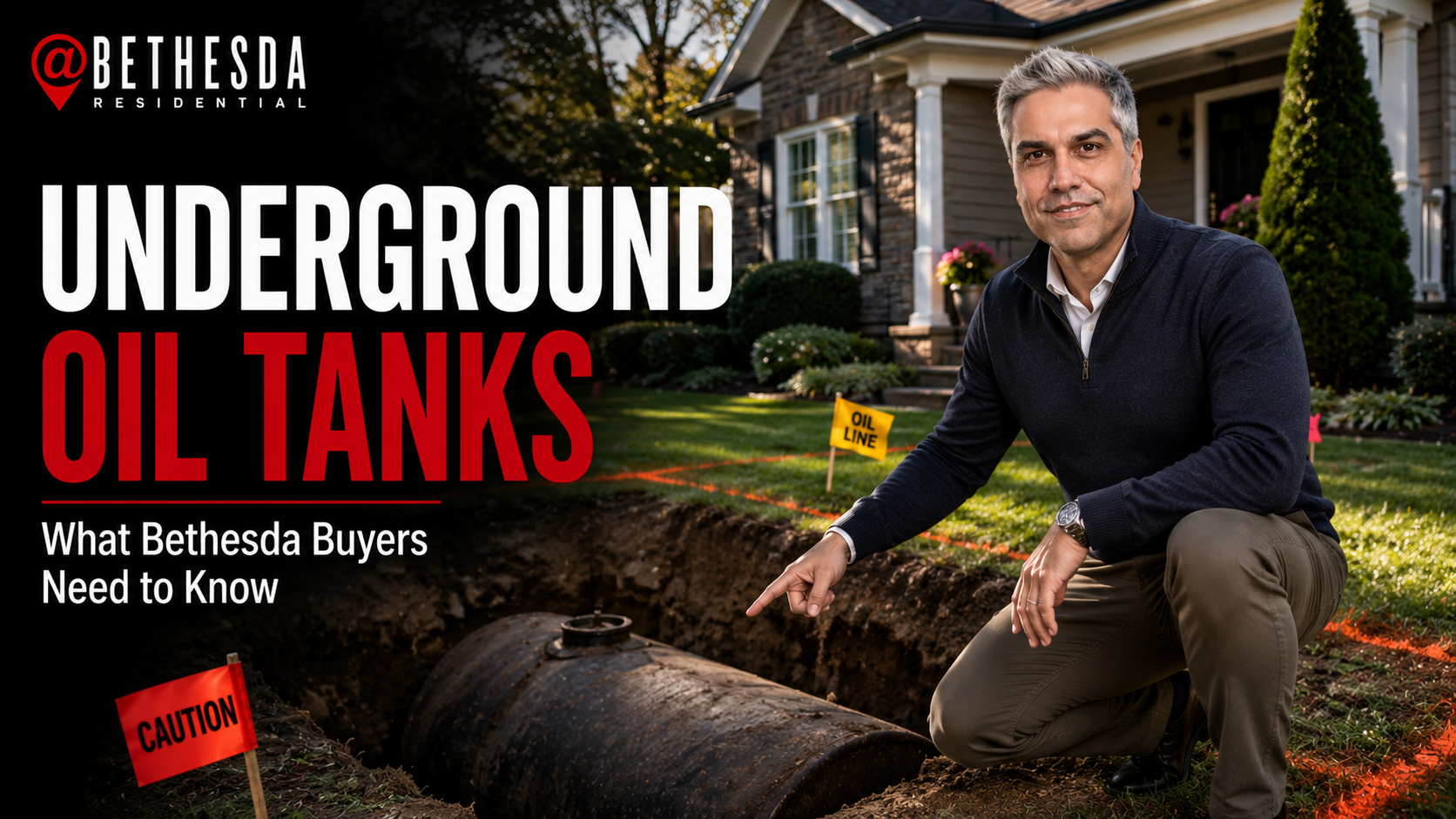
If you discover an underground oil tank when buying a home in Bethesda, Potomac, or Chevy Chase, the seller must remove or properly abandon it before closing — removal runs $900–$3,600, and many lenders won't close without it. Maryland's state reimbursement fund for cleanup costs was permanently canceled in July 2024.
Quick Answer
If you discover an underground oil tank when buying a home in Bethesda, Potomac, or Chevy Chase, the seller must remove or properly abandon it before closing — removal runs $900–$3,600, and many lenders won't close without it. Maryland's state reimbursement fund for cleanup costs was permanently canceled in July 2024.
A buried oil tank on a property you're buying — or selling — isn't automatically a dealbreaker. But it is something you need to resolve before closing, and the way you handle it matters. In Bethesda, Potomac, Chevy Chase, and across Montgomery County, older homes with oil heat are common. A significant number still have underground storage tanks (USTs) that were never removed when the heating system was converted to gas or electric.
If an underground oil tank shows up in a home you're under contract on — or if you're a seller who knows one is buried on your property — here's exactly what you're dealing with.
What an Underground Oil Tank Means for Your Transaction in Bethesda
Underground storage tanks were standard equipment in homes built from the 1950s through the 1980s. When natural gas service expanded through Montgomery County and homeowners converted to gas, electric heat pumps, or geothermal, the buried tanks were often just abandoned in the ground — sometimes with heating oil still in them.
The problem is that the average residential buried tank has a lifespan of about 20 years. According to the Maryland Department of the Environment (MDE), virtually every buried residential tank in the state is older than that. The most common residential size is 550 gallons, but 1,000-gallon tanks are especially prevalent in Potomac, Derwood, and Montgomery Village — a detail that matters because larger tanks mean greater potential contamination if they've failed.
All tanks corrode from the inside out. Whether a tank is actively leaking or just approaching the end of its life, the liability attaches to the property. If you buy a home with an unresolved underground oil tank issue, you inherit that liability — including any contamination that's already occurred, even if you had no prior knowledge of it.
That's the piece that catches buyers off guard. This isn't like a roof that needs replacing. A leaking underground oil tank can contaminate surrounding soil, reach neighboring properties, and — if the home has a well — require petroleum water testing that drags on for up to a year. The exposure is different in kind, not just degree.
Maryland Law on Underground Oil Tanks — and the 2024 Change You Need to Know
Maryland law requires that any underground storage tank no longer in active use must be properly removed or abandoned in place within 180 days — by a licensed tank removal contractor. There is no owner-DIY option here. It is also illegal to fill a UST through the fill pipe with foam, slurry, or cement, even if a contractor suggests it.
Abandonment in place is legal when the tank is clean and not leaking. But it still requires the tank to be physically excavated, cut open, and cleaned to MDE standards. "Abandonment" does not mean leaving it in the ground undisturbed.
One critical change took effect on July 1, 2024: the Maryland Homeowner Reimbursement Fund — which previously offered partial reimbursement for residential heating oil tank cleanup costs — was permanently canceled by the Maryland legislature. There is no longer any state reimbursement program. Many sources online still reference the old fund; as of mid-2024, those references are outdated. If your tank is leaking and remediation is required, the full cost is on whoever is contractually responsible — with no state offset available.
This change makes early resolution more important. Contamination that spreads to neighboring soil or groundwater becomes exponentially more expensive to remediate. Sellers who address a UST before listing are in a much stronger position than those who wait for it to surface during a transaction.
An underground oil tank is also a required disclosure under the Maryland Residential Property Disclosure and Disclaimer Statement. It's a material fact. Failing to disclose it creates legal liability after closing.
How a UST Affects Buyers and Sellers at the Closing Table
In nearly every residential transaction in Montgomery County, the seller is responsible for resolving the underground oil tank before settlement — through removal or proper abandonment, with contractor documentation ready for the lender and title company.
Three parties can stop your closing if a UST isn't resolved:
- Your mortgage lender. Many banks and mortgage companies will not close on a home with an unresolved underground storage tank. They'll require proof of removal or proper closure before approving financing — this applies across conventional, FHA, VA, and jumbo loans. Confirm your lender's specific policy during pre-approval, not three days before settlement.
- Your homeowners insurance company. Many insurers will refuse to write a policy on a property with an existing buried oil tank, or will exclude any oil-related damage from coverage. Without proof of insurance, the loan won't close.
- The title company. Settlement officers will flag an unresolved UST during the closing process. If it isn't documented as resolved, the closing is delayed until it is.
Some sellers try to handle this by offering a credit to the buyer for tank removal rather than addressing it before closing. This sounds cleaner, but it carries real risk for the buyer. If the tank turns out to be leaking and contamination is found, the buyer is now the owner of that problem — with no reimbursement fund to fall back on. What starts as a $2,000 removal credit can turn into a $15,000–$30,000 remediation project the buyer is managing alone.
The cleaner approach: sellers handle the tank before the home is listed or before going under contract, document it with a licensed contractor, and provide the buyer with a clean soil report. That removes the uncertainty that makes buyers nervous and lenders cautious — and it almost always produces a better sale outcome.
Buyers who discover an underground oil tank during due diligence should add a specific tank contingency to the contract — separate from the general inspection contingency. This gives you the right to exit or renegotiate based on tank inspection results and any soil test findings. A standard home inspection won't always surface a buried tank; a dedicated UST inspection runs $150–$400 and is worth it on any pre-1980s property in Bethesda, Potomac, or Chevy Chase with a history of oil heat.
Knowing which questions to ask and which inspections to order on older Bethesda and Potomac properties is part of what I bring to every buyer transaction. Environmental due diligence matters a lot more on pre-1980s homes, and getting it right protects your investment before you commit.
What Underground Oil Tank Removal Costs in Montgomery County
Tank removal for a residential UST in Maryland typically runs $900–$3,600, depending on tank size, access, and depth. A standard 550-gallon tank in Bethesda or Chevy Chase usually comes in around $1,500–$2,500 for a clean removal. The larger 1,000-gallon tanks common in Potomac and Montgomery Village cost more to excavate and haul away.
If soil samples taken during removal show petroleum contamination, the scope expands. Contaminated soil must be excavated and taken to a licensed disposal facility at $50–$200 per cubic yard. Most residential remediation jobs in Montgomery County come in under $10,000 total — but that assumes the contamination is localized. If oil has migrated toward a neighboring property, a French drain, or a sump system, the costs and timeline increase significantly.
One complication specific to Potomac and parts of North Bethesda: many properties in those areas are on well water rather than public water service. Normal well water tests do not include petroleum testing. If there's any indication a tank has leaked, MDE requires a separate petroleum water sample. If petroleum is detected, additional testing may be required for up to a year. That timeline can complicate a transaction significantly, especially when a clean well test is a lender requirement.
Normal environmental due diligence on an older MoCo home — radon, well water, lead paint — sometimes doesn't include a UST inspection unless it's specifically ordered. On any pre-1980s home with original or replaced heating systems and no clear record of prior tank removal, add the tank inspection to your due diligence list.
All of this factors into how to think about your total purchase costs on an older property. A home in Potomac with a buried oil tank isn't necessarily a bad deal — but it's a different deal than one without. The numbers need to reflect that.
If you're buying or selling in Bethesda, Potomac, Chevy Chase, or anywhere in Montgomery County and an underground oil tank is part of the picture, I'm happy to walk you through what to expect — from how to structure the contract to what documentation lenders will require. Reach out anytime.
About Pey Behin
Pey Behin is a residential real estate agent serving the Washington, DC metro area, with a focus on Bethesda, Montgomery County, and Northern Virginia. He works with buyers and sellers who want clear strategy, data-driven pricing, and direct guidance throughout the transaction process.