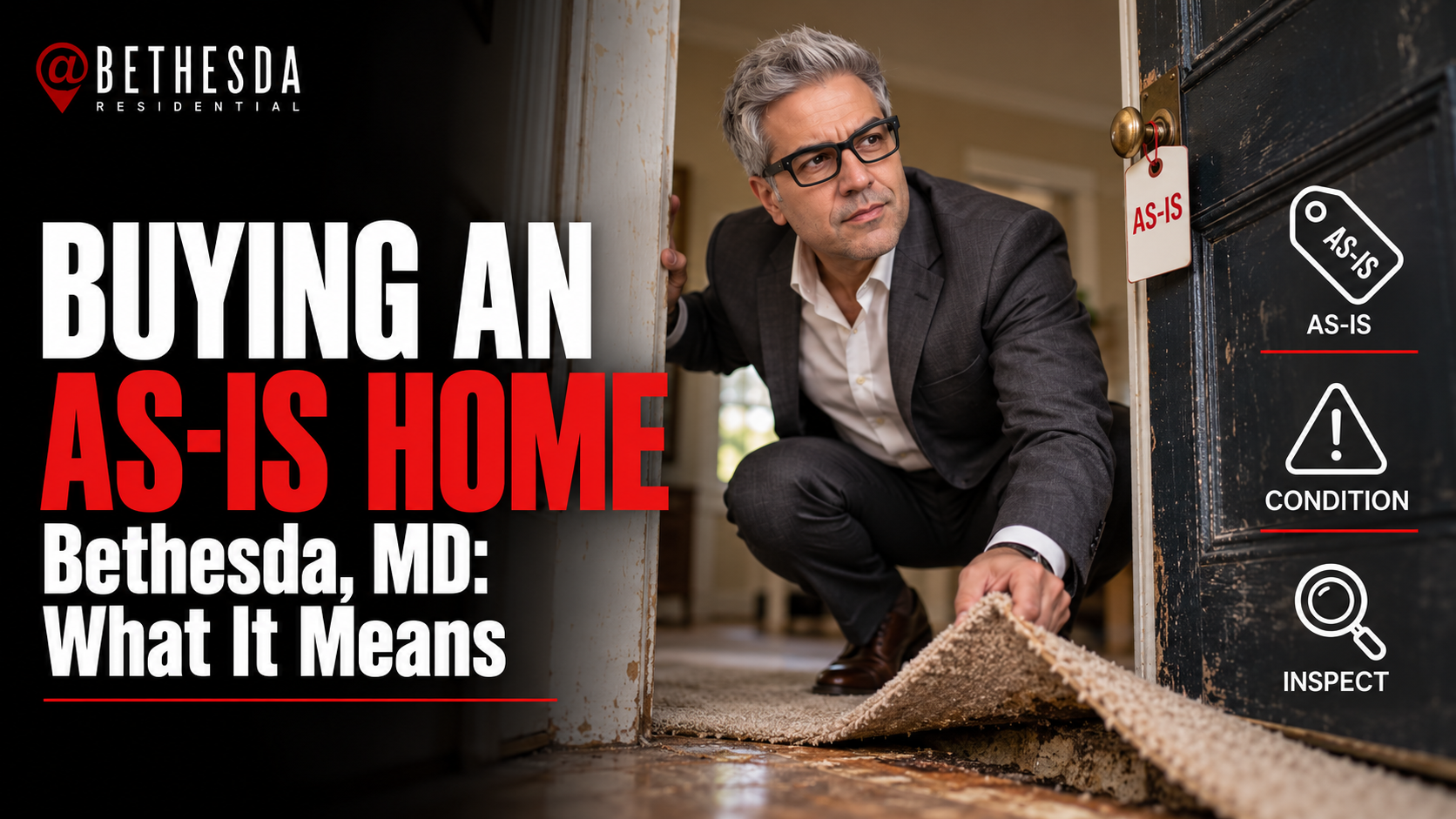
Buying an as-is home in Bethesda means the seller won't make repairs — but it doesn't cancel your right to inspect, and it doesn't cancel Maryland's disclosure rules. You can still get a full home inspection, renegotiate the price, or walk away, and FHA and VA loans still require the home to meet minimum property standards before closing. With Bethesda's median price near $1.275M, an as-is label is often about the seller wanting a clean, simple sale — not a warning sign.
Quick Answer
Buying an as-is home in Bethesda means the seller won't make repairs — but it doesn't cancel your right to inspect, and it doesn't cancel Maryland's disclosure rules. You can still get a full home inspection, renegotiate the price, or walk away, and FHA and VA loans still require the home to meet minimum property standards before closing. With Bethesda's median price near $1.275M, an as-is label is often about the seller wanting a clean, simple sale — not a warning sign.
You found a home you love in Bethesda, the listing looks like a deal, and then you see two words in the remarks: sold as-is. Suddenly the excitement gets tangled up with worry. Does that mean you're buying someone else's problems? Can you even get an inspection? Are you about to sink $1.3 million into a money pit?
Take a breath. Buying an as-is home in Bethesda is not the trap most buyers assume it is. It's one of the most common questions I get from buyers right now, and the reality is a lot more manageable than the label suggests. Let me walk you through what as-is actually means here, what protections you keep, and how to make a smart offer instead of an anxious one.
What Buying an As-Is Home in Bethesda Actually Means
An as-is sale means the seller is telling you upfront: I'm not making repairs, and I'm not offering credits for the condition of the house. What you see is what you get. If the water heater is on its last legs or the deck needs work, that's now your responsibility to plan for.
That's it. That's the whole promise. As-is is a statement about repairs — not about your right to investigate the property, and not about the seller's legal obligations to you.
Here's what as-is does not mean:
- It does not mean you can't get a home inspection.
- It does not mean you can't negotiate the price.
- It does not mean you can't walk away.
- It does not mean the seller can hide known problems.
In Bethesda, an as-is label often has nothing to do with the house being a disaster. Plenty of as-is listings come from estates settling an inherited property, out-of-state owners who don't want to manage a repair project from afar, or sellers of an older home who'd simply rather price it accordingly than get pulled into a repair negotiation. With the Bethesda median sale price sitting around $1.275 million and homes still moving in roughly two to three weeks, sellers here have the leverage to say "priced as-is" and mean "I'd rather adjust the price than fix things one at a time."
You Still Have the Right to Inspect
This is the single biggest misconception, so I'll say it plainly: in almost every Maryland as-is transaction, you keep the right to a home inspection.
Maryland contracts handle this through an as-is addendum, and it generally comes in two flavors:
- As-is with a home inspection contingency. You get your inspection period. If the inspection turns up something you can't live with, you can terminate the contract and get your earnest money back, or you can go back to the seller and ask for a price reduction. The seller isn't obligated to repair — but nothing stops them from accepting a lower number that reflects what the inspection found.
- As-is with an information-only inspection. You still hire an inspector and learn everything about the house, but you've agreed you won't ask for repairs or credits. Depending on how it's written, you may keep the right to walk away for a major defect, or you may have waived that too. This is where the exact contract language matters enormously.
Should you still pay for an inspection on a home the seller won't fix? Almost always, yes. An inspection on an as-is home isn't about building a repair list to hand back to the seller — it's about knowing exactly what you're buying before you commit. A few hundred dollars for a professional to check the roof, the systems, and the structure is cheap insurance against a five- or six-figure surprise after closing. If your as-is home shows any signs of structural or foundation problems, you'll want a specialist to weigh in before you go any further.
Just make sure — before you go under contract — that you know which version of the addendum you're signing. That's a very different decision from waiving the inspection entirely to win a competitive bid, and the two get confused constantly.
As-Is Doesn't Cancel the Seller's Disclosure Duty
Here's the protection buyers forget they have. In Maryland, an as-is clause covers repairs — it does not give the seller a license to conceal known defects.
Maryland sellers complete a Residential Property Disclosure and Disclaimer Statement. Sellers can choose to "disclaim," meaning they make no representations about the property's condition — which is common with estates and investor sellers who never lived in the home. But even a seller who disclaims still has a duty not to actively hide or misrepresent a known latent defect — a serious problem that isn't visible during a normal inspection and that they knew about.
So "as-is" and "disclaimer" are not the same thing as "you're on your own with no recourse." Understanding Maryland's seller disclosure rules tells you exactly what the seller is and isn't responsible for — and it helps you read an as-is listing for what it really is. When a seller disclaims and sells as-is, your inspection becomes your primary source of truth, which is all the more reason to do it thoroughly.
What As-Is Means for Your Loan — and Your Offer
An as-is agreement is between you and the seller. Your lender never signed it — and that matters more than most buyers expect.
If you're paying cash, you have the most freedom: inspect, decide, close. But if you're financing, the loan program has its own property standards that an as-is label cannot override:
- FHA and VA loans require the home to meet minimum property standards. Appraisers flag issues tied to safety, structure, and health — an active roof leak, exposed wiring, broken windows, peeling paint on a pre-1978 home, or non-working mechanical systems. If the appraisal calls for repairs, they generally have to be completed before closing, even when the listing says as-is. If the seller won't fix them and won't let you, an FHA or VA deal can stall.
- Conventional loans are usually more flexible on condition, but a lender can still require repairs for anything that affects safety or the home's value.
This is exactly why an as-is home and your financing have to be evaluated together, not separately. A house that's a clean cash purchase might need a repair-escrow strategy — or a different loan — if you're putting a mortgage on it. That's the kind of thing I sort out with buyers before we write the offer, so a financing snag doesn't blow up the deal three days before settlement.
When it comes to the offer itself, buying as-is doesn't change your basic tools — it changes how you use them. A few principles I coach Bethesda buyers through:
- Price the condition in. As-is caps the seller's repair obligation, not the price. If your inspection reveals $40,000 of deferred maintenance, that's a legitimate reason to offer less — or to ask for a reduction — even on an as-is home.
- Keep the right inspection contingency for your risk tolerance. On a competitive Bethesda listing you may lean toward information-only to strengthen your offer; on an older or estate property, the right to terminate is worth protecting.
- Budget for the repairs you find. Get real contractor numbers during your inspection window, not guesses. Knowing the true cost lets you decide with confidence instead of fear.
- Don't confuse as-is with "no room to negotiate." Even after the inspection, you can still negotiate after the inspection — just on price or terms rather than a punch list of fixes.
An as-is home in Bethesda can be a genuine opportunity — a well-located property at a fair price because the seller wanted a clean, simple sale. It can also hide real risk. The difference between the two isn't the label on the listing. It's whether you inspected carefully, read the disclosures for what they say, lined up your financing to match the condition, and priced the risk into your offer.