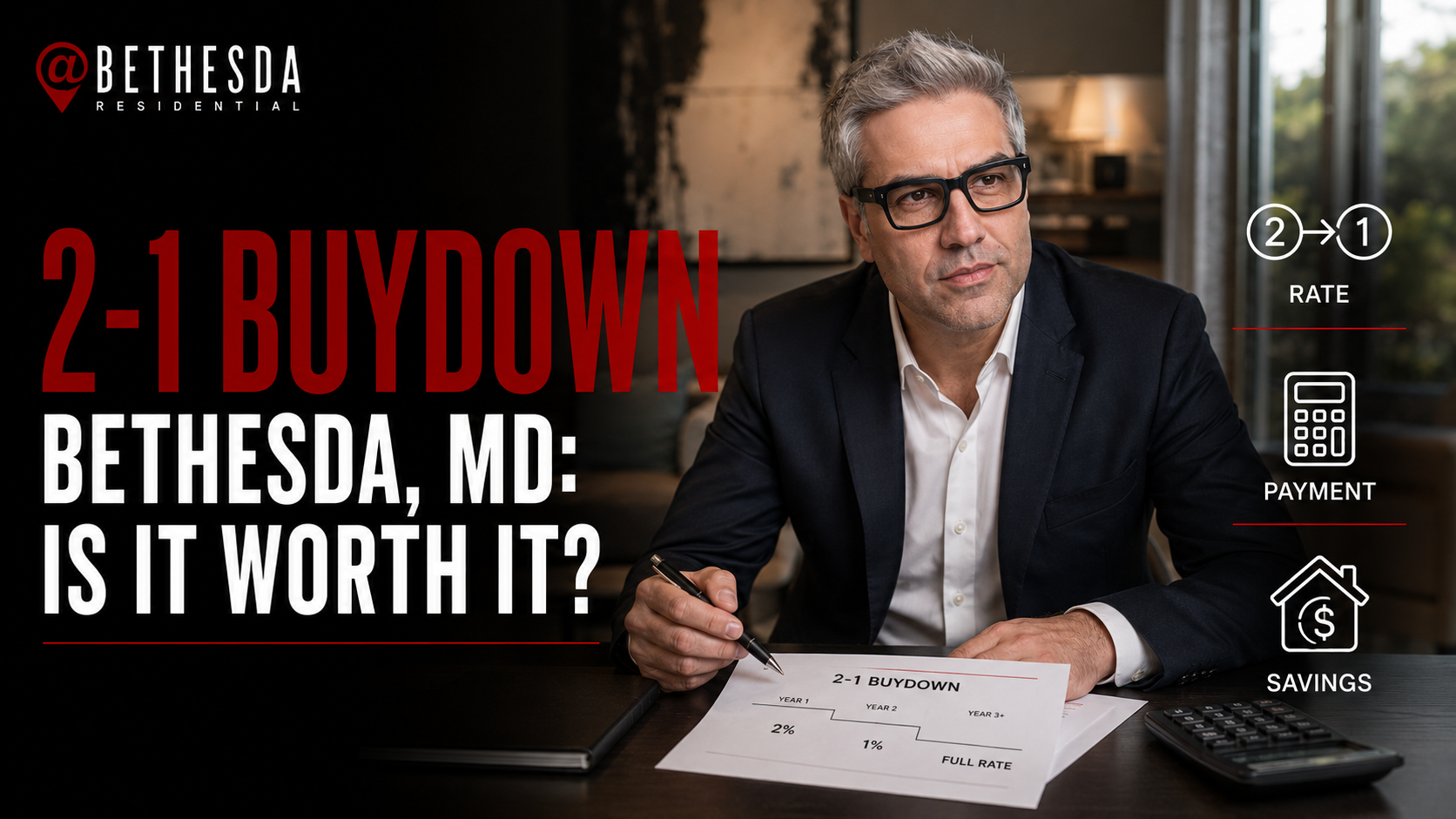
A 2-1 buydown temporarily lowers your mortgage rate by 2% in year one and 1% in year two before it settles at the full note rate in year three. On an $800,000 Bethesda loan at 6.6%, a 2-1 buydown saves roughly $1,000 a month the first year and costs around $18,000 up front — money a seller or builder often pays as an incentive rather than cutting the price. It works best when someone else funds it and you expect your income to rise or plan to refinance, because you still have to qualify at the full note rate.
Quick Answer
A 2-1 buydown temporarily lowers your mortgage rate by 2% in year one and 1% in year two before it settles at the full note rate in year three. On an $800,000 Bethesda loan at 6.6%, a 2-1 buydown saves roughly $1,000 a month the first year and costs around $18,000 up front — money a seller or builder often pays as an incentive rather than cutting the price. It works best when someone else funds it and you expect your income to rise or plan to refinance, because you still have to qualify at the full note rate.
Right now, the biggest lever on your monthly payment in Bethesda isn't the price you negotiate — it's the interest rate you carry into the first couple of years. With 30-year fixed rates sitting around 6.6% as of late August 2026, a lot of buyers are being offered a 2-1 buydown instead of a price cut, especially on new construction. Here's how to tell whether that's a real advantage or just a number that looks good on a flyer.
How a 2-1 buydown actually works in Bethesda
A 2-1 buydown temporarily lowers your interest rate for the first two years of the loan. In year one, your rate drops 2 percentage points below your note rate. In year two, it drops 1 point. Starting in year three, and for the rest of the loan, you pay the full note rate.
The key word is temporary. Your actual note rate is fixed from day one — the buydown doesn't change the loan you signed. Instead, a lump sum is set aside in an escrow account at closing, and each month that account covers the gap between your reduced payment and the full payment. When the account empties after 24 months, you're on the full rate.
So on an $800,000 loan at a 6.6% note rate, a 2-1 buydown means you'd pay as if the rate were 4.6% in year one and 5.6% in year two, before the payment steps up to the real 6.6% in year three. Nothing about the underlying mortgage changes — you're just getting a two-year head start on the payment.
Temporary buydowns are available on most fixed-rate loans — conventional, FHA, and VA — and many jumbo programs allow them too, which matters in Bethesda where a large share of homes push past the 2026 conforming limit of $1,249,125 in high-cost Montgomery County. They generally don't pair with adjustable-rate mortgages, since the point of the buydown is a predictable step-up to a fixed number. If your purchase is financed with a jumbo loan, confirm with your lender early, because not every jumbo investor permits a temporary subsidy.
What a 2-1 buydown costs — and who usually pays
The cost of a 2-1 buydown is simply the total of the payments it subsidizes. On that same $800,000 Bethesda loan, the math looks roughly like this:
- Year one at about 4.6% instead of 6.6%: roughly $1,000 less per month, or about $12,000 over the year.
- Year two at about 5.6%: roughly $500 less per month, or about $6,000 over the year.
- Total cost: around $18,000, funded up front and held in escrow.
Here's the part that changes the whole calculation: you rarely pay for a 2-1 buydown yourself. In today's market, the seller or builder almost always funds it as an incentive. That's why you see it so often on new construction — builders would rather buy down your rate than cut the sticker price, because a lower recorded sale price can drag down the comps for every other unit in the community. If you're weighing a builder's offer, it's worth understanding what to know before buying new construction in Bethesda so you can read the incentive package clearly.
A seller-funded buydown is counted as a seller concession, so it has to fit inside the contribution limits for your loan type. On a conventional loan, a seller can contribute up to 3% of the price if you put less than 10% down, 6% at 10% down or more, and 9% at 25% down or more. FHA caps seller contributions at 6%, and VA treats a temporary buydown as a concession under its 4% limit. On the price points common in Bethesda and Potomac, an $18,000 buydown fits comfortably within those limits — but it does compete with other things you might want that money to cover, which is where thinking through how to use a seller concession when buying in Bethesda matters.
2-1 buydown vs. a price reduction: which is better?
This is the real decision. Say a seller offers you either $18,000 off the price or an $18,000 2-1 buydown. They cost the seller the same. They are not the same for you.
A price cut of $18,000 on an $800,000 home barely moves your monthly payment — you're financing $18,000 less at 6.6%, which saves you a little over $100 a month for 30 years. A 2-1 buydown takes that same $18,000 and concentrates it into your first two years, when money is usually tightest right after closing. That's roughly $1,000 a month of relief in year one instead of $100.
So which wins? It depends on your time horizon. If you plan to stay in the home for many years and don't need the early cash flow, a price reduction quietly saves you more over the long run and lowers your loan balance permanently. If your budget is tight in the first year or two — new furniture, a renovation, a growing family — the buydown puts real dollars back in your pocket exactly when you need them. Neither answer is universally right, and that's the conversation worth having before you counter.
When a 2-1 buydown makes sense (and when it doesn't)
A 2-1 buydown tends to make sense when someone else is paying for it, when you reasonably expect your income to rise, or when you believe you'll refinance if rates fall. If you refinance or sell before the two years are up, you don't lose the unused subsidy — the remaining balance in the buydown escrow is applied to your payoff or credited back to you, so it's not wasted money.
It makes less sense when you'd be paying for it out of your own pocket. In that case, the same dollars often do more as permanent discount points or a straight price reduction. If a lower rate for the life of the loan is what you're after, compare this against paying mortgage points to lower your rate permanently before you commit.
The most important guardrail: you have to qualify at the full note rate, not the reduced rate. Fannie Mae, FHA, and VA all require the lender to underwrite you against the year-three payment. That's a good thing — it means the buydown can't stretch you into a house you can't actually afford once the subsidy ends. But it also means you should be genuinely comfortable with the full payment, not just the year-one number on the flyer. Getting a clear picture starts with a solid mortgage pre-approval in Maryland that shows you both figures side by side.
A 2-1 buydown is a genuinely useful tool in the 2026 Bethesda market, particularly with builders competing hard on incentives. The trap is treating the year-one payment as your real payment. Look at all three years, confirm who's funding it, and make sure the year-three number is one you'd sign up for on its own.
If you're weighing a builder's buydown offer or trying to decide between a rate buydown and a price cut on a Bethesda or Potomac home, I'm happy to run the numbers with you side by side so you can see exactly what each one does for your budget. Reach out anytime.
About Pey Behin
Pey Behin is a residential real estate agent serving the Washington, DC metro area, with a focus on Bethesda, Montgomery County, and Northern Virginia. He works with buyers and sellers who want clear strategy, data-driven pricing, and direct guidance throughout the transaction process.