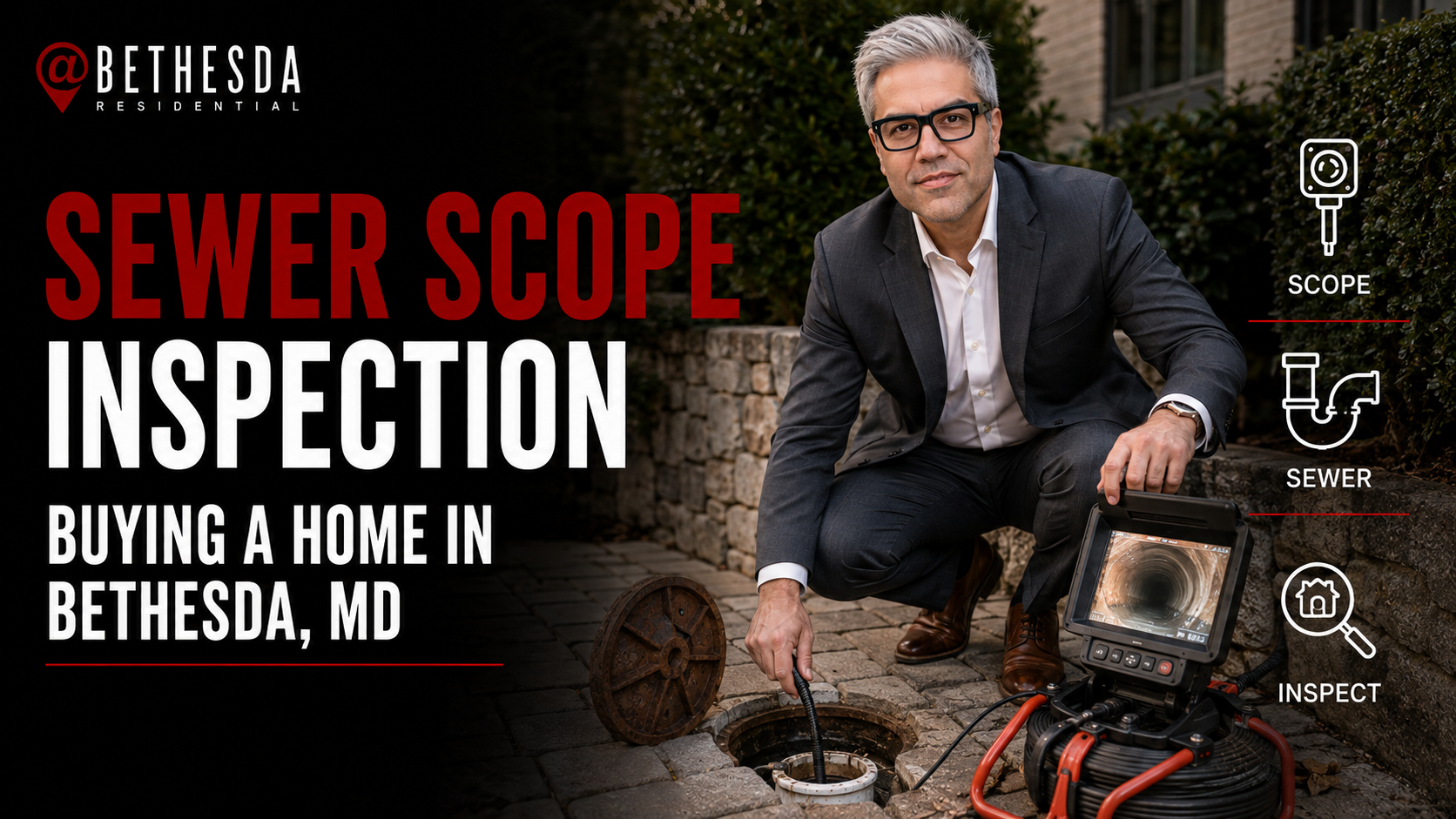
A sewer scope inspection sends a camera down the home's sewer lateral to check for cracks, root intrusion, and collapse before you buy. In Bethesda it runs about $180–$220 — a small price against a $10,000–$30,000 lateral replacement, and worth it for any home built before the 1980s or on a tree-lined lot.
Quick Answer
A sewer scope inspection sends a camera down the home's sewer lateral to check for cracks, root intrusion, and collapse before you buy. In Bethesda it runs about $180–$220 — a small price against a $10,000–$30,000 lateral replacement, and worth it for any home built before the 1980s or on a tree-lined lot.
You've found the house. It's a solid brick colonial off a quiet Bethesda street, mature oaks in the yard, the kind of place that's held its value for fifty years. The general inspection comes back clean. So you're good, right?
Not quite. The one system a standard home inspection almost never checks is the one buried under that beautiful, tree-lined lawn: the sewer lateral, the private pipe that carries everything from your house to the public main. When it fails, you're not looking at a $400 repair. You're looking at five figures. And the only way to see inside it before you buy is a sewer scope inspection.
Here's when older-home buyers in Bethesda and Montgomery County actually need one, what it costs, and how to use what it finds.
What a sewer scope inspection actually is
A sewer scope inspection is simple in concept: a technician feeds a flexible waterproof camera down the home's sewer cleanout and runs it through the lateral line all the way to the connection at the public main. You watch the video in real time. Cracks, root intrusion, sagging "bellies" where waste pools, corrosion, and outright collapse all show up on screen.
This is not part of a general home inspection. Your standard inspector checks what's visible and accessible — they'll run the faucets and note that drains flow, but they cannot see thirty feet of pipe buried four feet underground. A sewer scope is a separate service, usually booked with a specialized inspector or a licensed plumber, and it's the only tool that tells you the true condition of a line you're about to become financially responsible for.
It's the same logic behind other targeted checks buyers order in this market. Just as you'd order radon testing or a termite inspection to catch what the general inspection misses, a sewer scope covers a specific, expensive blind spot.
Why older Bethesda and Chevy Chase homes are especially at risk
Two things make the DC metro's established neighborhoods a hotspot for sewer trouble: old pipes and big trees.
Homes built before the 1980s were often plumbed with clay tile or, in some cases, Orangeburg — a tar-paper-and-wood-pulp pipe that degrades over time. Both materials have joints every few feet, and both are now at or past their service life. Bethesda, Chevy Chase, and older pockets of Potomac and North Bethesda are full of exactly these houses.
Then there's the tree canopy. The same mature oaks, maples, and willows that make these streets so desirable send aggressive roots toward the steady water source running through your lateral. Roots find the joints, work their way in, and slowly choke or crack the line. Warning signs a scope can confirm include:
- Slow drains or gurgling toilets throughout the house, not just one fixture
- Sewage backing up into the lowest drains or the basement
- Persistent sewer odor indoors or in the yard
- Soggy patches or an unusually green, fast-growing strip of grass tracing the pipe's path
- A seller history of repeated "we had to snake it again" service calls
You won't always see these signs during a showing, which is the whole point. A line can be one heavy rain away from failing and still flush fine on the day you walk through.
What a sewer scope inspection costs — and what a failure costs you
This is where the math makes the decision easy. A sewer scope inspection in the Bethesda area typically runs about $180 to $220, sometimes a bit more if the run to the street is unusually long or the cleanout is hard to access. Across Maryland you'll see $150 to $300.
Now the other side of the ledger. If the scope reveals a failing line, here's the range you're weighing it against:
- Clearing roots or a routine cleaning: $100–$600
- Spot repair of a single damaged section: roughly $700 to a few thousand dollars
- Full lateral replacement: commonly $10,000–$15,000, and $30,000 or more when the line runs deep, under mature landscaping, or beneath a driveway or roadway that has to be restored
Spending a couple hundred dollars to avoid inheriting a five-figure repair is one of the clearest returns you'll find in a home purchase.
One more thing Bethesda buyers get wrong: the assumption that the water utility handles it. In WSSC Water's service area — which covers Montgomery County — the dividing line is your property line. WSSC maintains the lateral from the public main to the property line; everything from the property line to the house, plus all the pipes inside, is the homeowner's responsibility. On a typical lot, that means the expensive stretch is yours, not the county's. Buying the house means buying that pipe.
When do you need a sewer scope?
You don't need to scope every house, but you should strongly consider one in any of these situations:
- The home was built before roughly 1985. Clay and Orangeburg lines are common in this era and simply age out.
- There are large, mature trees between the house and the street — the norm in Bethesda, Chevy Chase, and Kenwood.
- The home sat vacant or was a rental, where drainage problems may have gone unreported.
- You noticed any warning sign during showings — a faint odor, a slow drain, a suspiciously lush patch of lawn.
- It's a flip or a recent renovation. Cosmetic updates rarely include the buried lateral, and a fresh kitchen can distract from a forty-year-old pipe.
Homes on private septic rather than public sewer are a different conversation — there the focus shifts to the tank and drain field, which I cover in the guide to buying a home on well and septic in Potomac. For everything connected to the WSSC system, the scope is your tool.
In a competitive Bethesda market, some buyers feel pressure to strip contingencies to win. Before you do, read whether you should waive the home inspection to win a bid — because waiving your inspection window usually means giving up the right to scope the line, too.
What to do if the scope finds a problem
A failed sewer scope isn't automatically a deal killer. It's leverage and information. If you're still inside your inspection contingency, you have real options:
- Ask the seller to repair or replace the line before closing, using a licensed plumber and providing documentation.
- Negotiate a credit toward the repair, so you control the work and the contractor after closing.
- Request a price reduction that reflects the full replacement cost, plus a cushion for the unknowns that come with digging.
- Walk away if the seller won't move and the number is too big for your budget — while you still can, penalty-free.
Which path makes sense depends on the severity, the rest of the deal, and how the home is priced. Getting a written estimate quickly, while the contingency clock is running, is what turns a scary video into a solid negotiating position. This is the same playbook I walk clients through in how to negotiate after a home inspection in Bethesda — findings only help you if you act on them inside your window.
The bottom line
For a couple hundred dollars, a sewer scope turns the single most expensive hidden risk in an older Bethesda home into something you can see, price, and negotiate. On a pre-1985 house with big trees out front, it's not an optional extra — it's due diligence. If you're weighing an offer on an older home in Bethesda, Chevy Chase, or Potomac and want to think through whether to scope it and how to structure your contingencies, reach out anytime. I'm happy to walk you through it.
About Pey Behin
Pey Behin is a residential real estate agent serving the Washington, DC metro area, with a focus on Bethesda, Montgomery County, and Northern Virginia. He works with buyers and sellers who want clear strategy, data-driven pricing, and direct guidance throughout the transaction process.