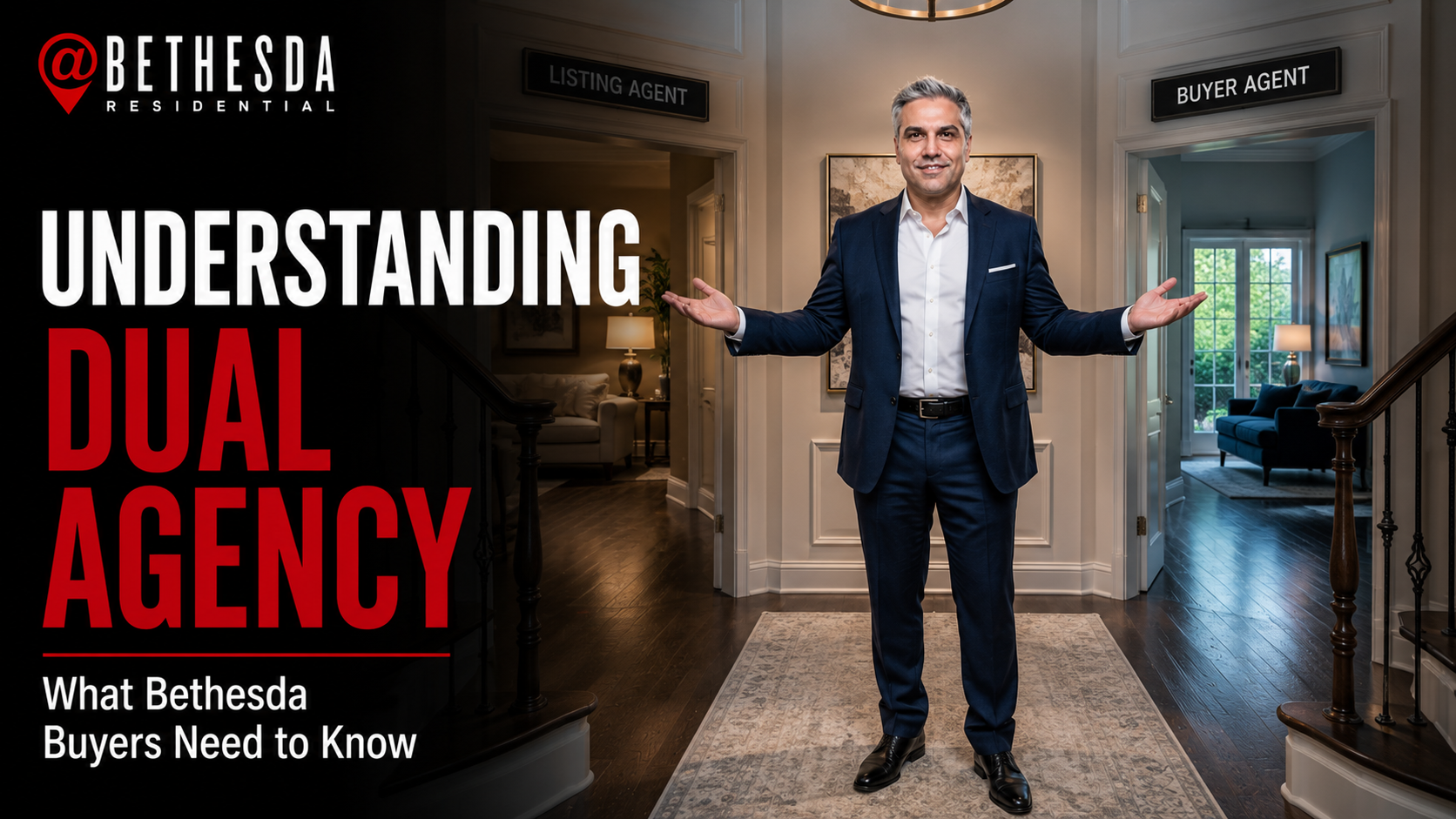
In Maryland, dual agency occurs when your buyer's agent and the listing agent work for the same brokerage. Maryland law (§17-530.1) makes the broker—not either individual agent—the dual agent, requiring a written "Consent for Dual Agency" form from both parties. Your assigned intra-company agent still represents you exclusively; the broker cannot advise on terms, counteroffers, or share confidential information with either party.
Quick Answer
In Maryland, dual agency occurs when your buyer's agent and the listing agent work for the same brokerage. Maryland law (§17-530.1) makes the broker—not either individual agent—the dual agent, requiring a written "Consent for Dual Agency" form from both parties. Your assigned intra-company agent still represents you exclusively; the broker cannot advise on terms, counteroffers, or share confidential information with either party.
You've been searching for months. You finally walk into a Bethesda home—something in Chevy Chase, maybe, or North Potomac—and you know it's the one. Then your agent pulls up the listing details and pauses.
"This one is listed by our office."
What happens next depends on a piece of Maryland real estate law that most buyers have never heard of—and misunderstand when they do. Here's a clear explanation of how dual agency in Maryland works, what you actually sign when it comes up, and how to think through your options before you're under contract on a $1.5 million home.
How Dual Agency Works in Maryland
In most states, "dual agency" means a single agent represents both the buyer and the seller in the same transaction. That's widely seen as a conflict of interest—one person can't fully advocate for both sides of a negotiation at once.
Maryland handles this differently. Under Maryland Business Occupations and Professions § 17-530.1, when your buyer's agent and the seller's listing agent both work for the same brokerage, it's the broker—not either individual agent—who becomes the dual agent. The broker then assigns:
- One intra-company agent to represent the seller exclusively
- A different intra-company agent to represent the buyer exclusively
Your individual agent doesn't change roles. They still work for you. The broker is the one caught in the middle—and Maryland law requires a written form acknowledging that before the transaction can go forward.
This structure—broker neutral, individual agents each representing their own client—is what most other states call "designated agency." Maryland simply uses the term "dual agency" because it's the broker filling both roles, not the agents. The terminology confuses buyers, but the practical effect is much closer to designated agency than to the true dual-representation model many people fear.
The consent form is mandatory
Before the transaction can move forward, both the buyer and the seller must sign the Maryland Real Estate Commission's official "Consent for Dual Agency" form. This isn't buried in the purchase contract—it's a separate, specific document you must actively agree to.
The form spells out exactly what the broker can no longer do once you sign:
- Cannot owe undivided loyalty to either party
- Cannot advise either party on the terms, offers, or counteroffers
- Cannot advise the buyer on the suitability or condition of the property
- Cannot disclose confidential information about one party to the other
If either party refuses to sign, the brokerage must end its representation of the buyer, the seller, or both for that specific property. The transaction can still happen—you'd just need to find a different buyer's agent from a different brokerage for that home.
It's also worth knowing that the same consent requirement applies if you were already working with the brokerage under a buyer broker agreement. That agreement doesn't automatically authorize dual agency—the separate consent form is still required each time it arises.
The team-level scenario adds another layer
Maryland's rules have one more wrinkle: if your buyer's agent and the listing agent are on the same team within the same brokerage—not just the same company—a separate MREC form called "Consent to Dual Agency Within a Team" is required.
This matters because agents on the same team communicate more closely, share leads, and often have financial incentives tied to shared team production. The conflict at the team level is deeper than two agents who simply happen to work for the same large broker across a big office.
In Bethesda and across Montgomery County, where large real estate teams at major brokerages hold meaningful shares of the listing inventory, team-level dual agency comes up more often than most buyers expect. It's worth asking about early—before you're emotionally invested in a specific home.
What You Give Up When You Consent to Dual Agency in Maryland
Here's where buyers either over-panic or under-react. Let's separate what actually changes from what stays the same.
What you don't lose: your individual agent's representation. Your intra-company agent still owes you exclusive loyalty, must maintain confidentiality about your motivations and financial position, must disclose material facts about the property, and must advocate for your interests throughout the negotiation. The limitation is at the broker level—not the agent level.
What you do give up: the broker's strategic backstop. In a standard buyer representation relationship, if a difficult decision arises—whether to push harder after an inspection, how to structure an escalation cap, whether a specific concession request makes sense—your agent can consult the broker for guidance and advocacy on your behalf. Under dual agency, the broker can't advise either side. If your agent runs into a wall and needs backup, the brokerage has to stay neutral.
On a Bethesda home priced between $1.2 million and $1.8 million, the stakes of every negotiating decision are real. A $15,000 credit for a needed repair, a price reduction after an inspection reveals deferred maintenance, or an escalation clause structured precisely to win without overpaying—these moves can materially change what you pay. Having full broker-level advocacy in the background matters more than buyers realize until they're in the middle of a difficult back-and-forth.
There's also an information dimension to this. Under dual agency, the broker cannot proactively share seller-side information that might influence your offer strategy—even information the broker might otherwise have shared to help you make a more informed decision. The broker's hands are tied. This doesn't mean your agent becomes less effective, but it does mean the brokerage as an institution can't lean toward your side of the transaction.
This is exactly the kind of thing worth talking through before you're in contract. I walk my clients through these scenarios whenever dual agency comes up—and at the price points common in Bethesda and Potomac, it's worth a real conversation, not a quick verbal explanation at the listing appointment.
What to Do If You're Facing a Dual Agency Situation
If your agent tells you the home you want is listed by their brokerage, you have three real paths. All of them are legitimate—none is automatically right for every situation.
Option 1: Consent to dual agency and proceed. If you trust your agent's ability to represent you effectively, believe the property is worth it, and the negotiating dynamics are reasonably straightforward, this is the most common path. Sign the consent form with full awareness of what the broker can and can't do, and move forward. Your agent still works for you—exclusively.
Option 2: Decline consent and engage a different buyer's agent for that property. If you want fully unconflicted representation on this specific home, decline the consent form. The brokerage is then required to release one of the parties from representation. You could engage a buyer's agent from a different brokerage for that transaction while your current agent continues representing you on everything else. It adds a layer of complexity, but it's a completely legitimate path—and sometimes the smarter one.
The right choice depends on the property, the price, and the nature of the transaction. In a competitive multiple-offer situation where you need aggressive strategy and clear advocacy, unconflicted representation carries more value. In a straightforward purchase with a clear market price and minimal negotiating tension, the practical impact of dual agency may be limited.
One habit worth building early in your search: ask your buyer's agent directly whether their brokerage holds listings in your target neighborhoods. A good agent will tell you without hesitation, and if dual agency is a concern for you, you can build your search strategy around it from the start—rather than learning about it when you're already in love with a house.
Understanding how buyer representation works in Maryland isn't just a legal technicality—it directly affects who's in your corner when you need it most. If you want to talk through what makes sense for your situation, I'm happy to walk you through it. Reach out anytime.
For a full picture of what to expect from your buyer's agent relationship, see what to expect at closing as a Maryland buyer. And for a full breakdown of what you'll pay at settlement, see buyer closing costs in Bethesda.
For full disclosure, in regular non-investor transactions, Pey Behin does not engage in Dual Agency transactions as his belief is it's impossible to ethically represent the buyer and represent the seller in the same transactions while advocating for both individually.
About Pey Behin
Pey Behin is a residential real estate agent serving the Washington, DC metro area, with a focus on Bethesda, Montgomery County, and Northern Virginia. He works with buyers and sellers who want clear strategy, data-driven pricing, and direct guidance throughout the transaction process.