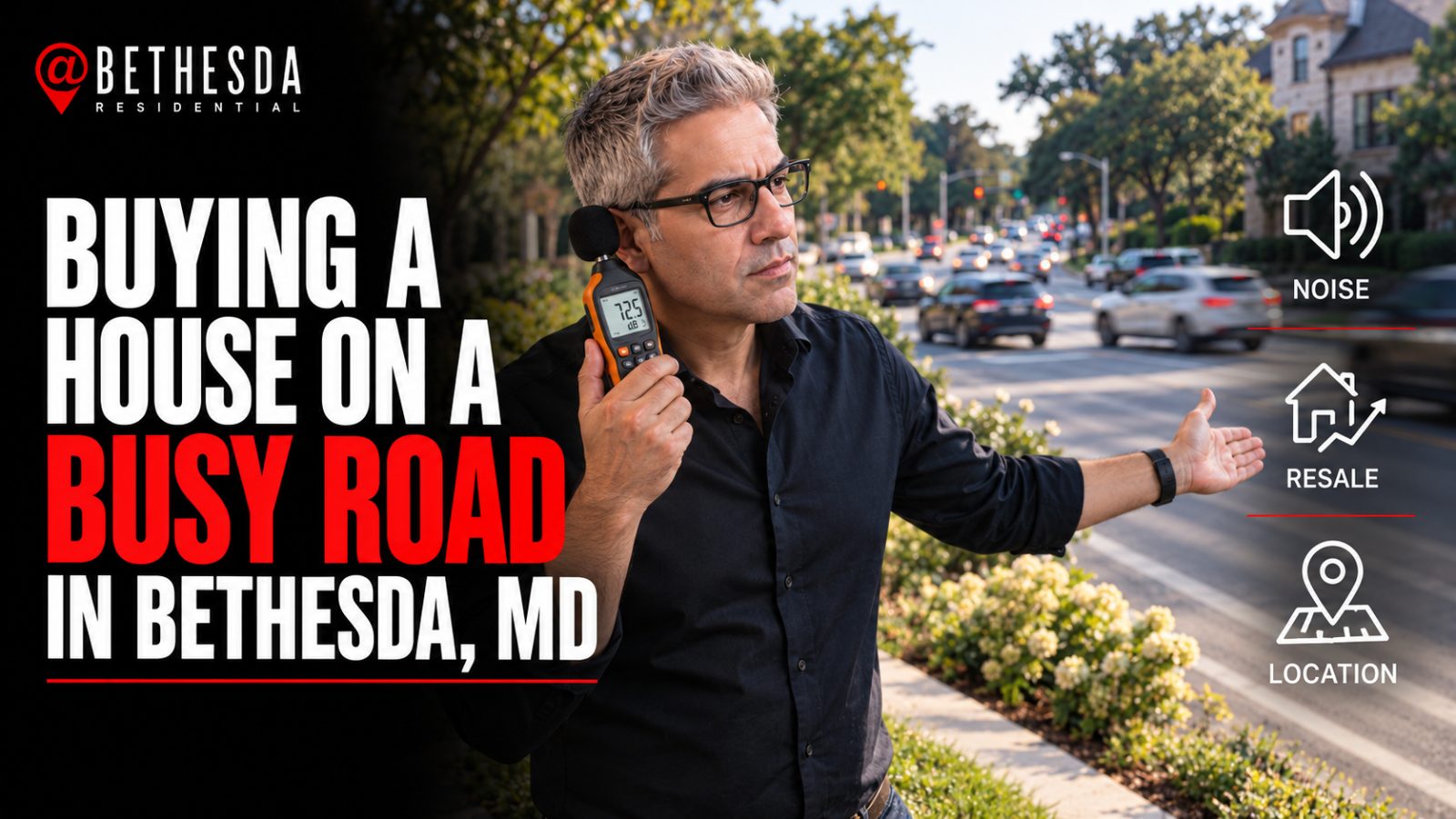
Buying a house on a busy road in Bethesda usually means paying 5–15% less than you'd pay for a comparable home on a quiet street — appraisers treat heavy traffic as external obsolescence and adjust for it. The trade-off is a smaller resale pool and longer days on market when you sell, though Bethesda's chronically low inventory tends to narrow the discount. Before you offer on a home along Rockville Pike, Old Georgetown Road, or River Road, weigh the price break against noise, safety, and how the MD 355 Flash BRT corridor could reshape the street.
Quick Answer
Buying a house on a busy road in Bethesda usually means paying 5–15% less than you'd pay for a comparable home on a quiet street — appraisers treat heavy traffic as external obsolescence and adjust for it. The trade-off is a smaller resale pool and longer days on market when you sell, though Bethesda's chronically low inventory tends to narrow the discount. Before you offer on a home along Rockville Pike, Old Georgetown Road, or River Road, weigh the price break against noise, safety, and how the MD 355 Flash BRT corridor could reshape the street.
Here's the honest version of the answer most agents soften: buying a house on a busy road in Bethesda usually means paying less — often 5 to 15 percent less — than you'd pay for a nearly identical home a block away on a quiet street. On a $750,000 Bethesda home, that can be $40,000 to $110,000 left in your pocket. The savings are real. The question is whether they're worth what comes attached to them.
I walk buyers through this trade-off constantly, especially along Bethesda's major arterials — Rockville Pike, Old Georgetown Road, Wisconsin Avenue, River Road, Bradley Boulevard, and Connecticut Avenue. In a market this starved for inventory, a busy road is one of the few ways to buy into a prime location for noticeably less. But a lower price today can turn into a slower, harder sale tomorrow. Let's look at both sides with clear eyes.
What to know before buying a house on a busy road in Bethesda
Appraisers have a name for a busy road: external obsolescence. It means something beyond your property lines — traffic, noise, headlights, limited on-street parking — pulls down value in a way you can't fix. You can remodel a kitchen. You can't move the road.
When a home gets appraised, the appraiser adjusts comparable sales for that road. A working appraiser's paired-sales analysis — busy-street homes measured against similar quiet-street homes — commonly puts the adjustment around 6 percent on the conservative end and 15 to 20 percent when traffic is heavy and buyers have other options. Research on traffic noise points the same way: homes exposed to roadway noise above roughly 80 decibels can give up close to 10 percent of value versus a quiet suburban baseline. Understanding how a home appraisal works helps you see why this adjustment sticks.
So the discount isn't a myth or a negotiating gimmick. It's a documented adjustment the market makes — and the same one that will apply when you're the seller. Buying a house on a busy road only pays off when you treat that discount as something you'll have to defend again at resale, not a one-time win.
How much less should you actually pay?
There's no universal number, and anyone quoting you a flat “10 percent off” is guessing. The size of the discount moves with a handful of factors:
- Traffic volume and speed. A 25 mph residential connector is a different animal than a six-lane stretch of Rockville Pike. More cars and higher speeds mean a bigger adjustment.
- Setback and buffer. A home set well back behind mature trees, a sound wall, or a berm suffers far less than one whose front steps nearly meet the sidewalk.
- Market conditions. This is the big one in Bethesda. When inventory is tight and buyers are competing — the norm here — the discount shrinks because buyers can't afford to be picky. In a soft market, the gap widens fast.
- Condition and updates. An updated, larger home on a busy road holds value better than a dated one. A tired house on a busy road is where you see the steepest discounts.
Right now I tell Bethesda buyers to expect the busy-road discount at the smaller end of that range, precisely because inventory is so thin — buyers can't afford to be choosy. That's a gift going in. It's also a warning coming out, because that same thin inventory may not be there to protect your price when you sell.
Your real number depends on the exact street, the exact house, and the timing. That's what a genuine paired-sales analysis is for, and it's one of the first things I run before a client offers on a home like this.
It's worth naming the upside, too. Homes on busy roads often sit on larger or deeper lots, land closer to Metro, shopping, and commuter routes, and let you stretch into a price point — or a square footage — a quiet street simply wouldn't allow. For the right buyer, that's a genuine trade, not a consolation prize.
The resale side: who buys the house after you
A busy road doesn't only change what you pay. It shapes who you can sell to later.
Every busy-road listing starts with a smaller buyer pool. Many buyers screen these homes out over safety or noise before they ever tour. A smaller pool usually means longer days on market and less competition — the mirror image of the quick, multiple-offer sales quiet Bethesda streets routinely see. Appraisers and agents alike note that busy-road homes tend to sell at the lower end of their value range unless they're truly updated.
That's not a dealbreaker — it's a planning fact. Buy at a real discount, price it honestly when you sell, present it well, and a busy-road home moves. The sellers who get stuck are the ones who ignored the road going in, then priced as if it didn't exist going out.
It's the same dynamic I cover with buyers weighing homes near the Purple Line or on a flag lot — any location factor you accept at purchase is one you'll negotiate again at sale. Accept it knowingly and it works for you. Ignore it and it works against you twice.
How to decide — and what to check first
If the numbers tempt you, do this before you write an offer:
- Visit at rush hour and on a weekend. A street can be calm at 11 a.m. and a wall of noise at 6 p.m. Stand in the backyard. Open a window. Judge it at its worst, not its best.
- Check what's planned for the road. Montgomery County's MD 355 Flash Bus Rapid Transit project runs the length of Rockville Pike and is in active development. Dedicated bus lanes, new stations, and lane changes can mean years of construction near your front door — and a different street when it's done. Look up the county's plans for any corridor you're considering.
- Get a real inspection, inside and out. Older homes on arterials sometimes carry deferred maintenance and road-related wear. A thorough home inspection tells you what you're actually buying.
- Price the mitigation. Double-pane windows, a solid fence, and dense landscaping genuinely cut noise and add privacy. Factor those costs into your offer — they're part of the true price.
- Confirm the discount is real. Compare the asking price against recent quiet-street sales of similar homes. If the busy-road home isn't priced meaningfully below them, the main reason to accept the trade-off disappears.
Done right, buying a house on a busy road can be one of the smarter value plays in Bethesda — a path into a location and price point that would otherwise be out of reach. Done carelessly, it's a home you overpay for and then fight to unload. The entire difference is in the homework.
If you're looking at a home on one of Bethesda's busier streets and weighing whether the price makes up for the road, that's exactly the call I help buyers make — with a paired-sales analysis, not a gut guess. Reach out anytime and we'll run your specific numbers before you offer.
About Pey Behin — Pey Behin is a residential real estate agent serving the Washington, DC metro area, with a focus on Bethesda, Montgomery County, and Northern Virginia. He works with buyers and sellers who want clear strategy, data-driven pricing, and direct guidance from the first showing through closing.