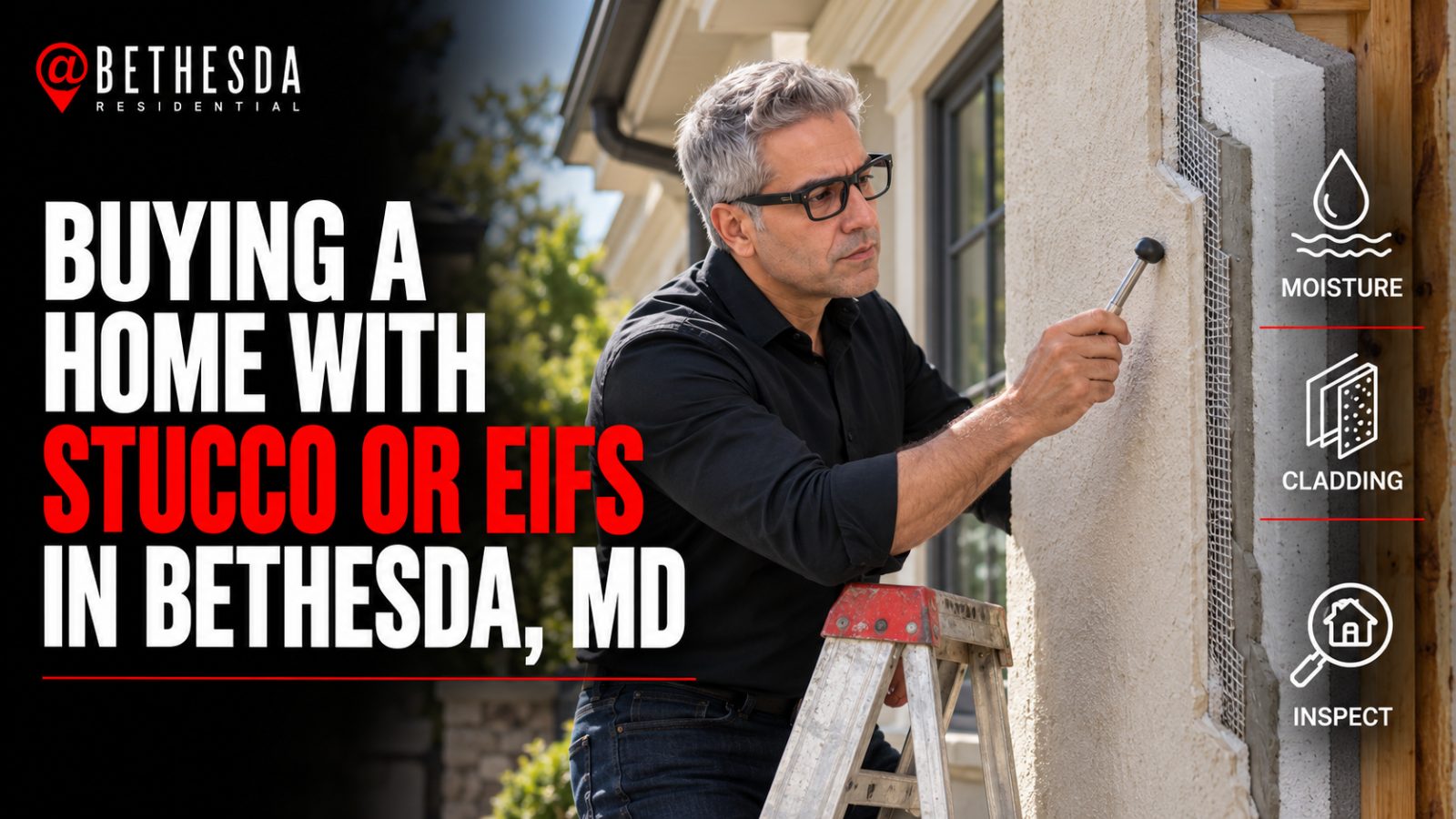
Before buying a home with stucco in Bethesda, find out whether it's traditional hard-coat stucco or EIFS. Hard-coat is generally low-risk; older EIFS can trap water and rot the sheathing. Get a specialist moisture inspection — about $850 — before removing your contingency, since fixes can run from a few thousand dollars to $25,000–$60,000.
Quick Answer
Before buying a home with stucco in Bethesda, find out whether it's traditional hard-coat stucco or EIFS. Hard-coat is generally low-risk; older EIFS can trap water and rot the sheathing. Get a specialist moisture inspection — about $850 — before removing your contingency, since fixes can run from a few thousand dollars to $25,000–$60,000.
Bethesda, Potomac, and Chevy Chase have no shortage of homes wrapped in stucco — the smooth, seamless look that took over high-end construction in the 1990s and early 2000s. If you're buying a home with stucco in this market, the first question isn't whether you like how it looks. It's what's actually behind it.
There are two very different products that both get called "stucco," and the gap between them can cost you tens of thousands of dollars. Traditional hard-coat stucco is a cement-based finish that's been used for a century and generally holds up well. EIFS — Exterior Insulation and Finish System, also called synthetic stucco or by the brand name Dryvit — is a foam-based system that looks nearly identical from the curb but behaves very differently when water gets involved.
Here's how to tell them apart, what to inspect, and how to protect yourself before you remove a single contingency.
What to know before buying a home with stucco in Bethesda
When you're buying a home with stucco, step one is identifying which system you're actually looking at.
Traditional stucco is three coats of cement applied over lath. It's hard, it sounds solid when you knock on it, and small cracks are usually cosmetic. It's a proven cladding and rarely a reason to walk away from a house.
EIFS is different. It's expanded polystyrene foam board with a thin synthetic coating troweled on top. Knock on it and it sounds hollow; press on it and it may give slightly. It was popular on larger custom and semi-custom homes around Bethesda, Potomac, and North Potomac from the mid-1990s through the mid-2000s — exactly the era of teardown-and-rebuild luxury construction here.
A few quick ways to narrow it down:
- The knock test — a hollow sound points to foam (EIFS); a hard, solid sound points to cement stucco.
- The push test — noticeable give or a soft spot can mean loose or wet material.
- Paperwork — the name "Dryvit" or "synthetic stucco" on old permits, plans, or the seller's disclosure is a strong tell.
- Age — treat a pre-1995 home as barrier (face-sealed) EIFS until proven otherwise, verify anything built between 1995 and 2008, and know that wood-framed homes built from 2009 on were required to use a drainable system.
None of these is definitive. The only way to confirm is to have a specialist open a small test area — which is exactly why the inspection matters so much on these homes.
Why synthetic stucco (EIFS) carries hidden risk
The problem with older EIFS isn't the foam. It's water with no way out.
Barrier, or face-sealed, EIFS was designed to keep every drop of water on the outside. There's no drainage plane behind the foam, so when water does get in — around a window, a deck ledger, a roofline, or a cracked seal — it has nowhere to drain. It sits against the wood sheathing and framing and can rot the structure for years while the exterior still looks flawless. Building scientists have criticized face-sealed systems for exactly this reason, and water-intrusion lawsuits against barrier EIFS date back to the late 1980s. A national class-action settlement involving Dryvit was approved in 2003, and at least one national homebuilder stopped using the material in 1998.
Newer drainable EIFS adds a drainage plane behind the foam so trapped water can escape, and it performs far better. That's the system required on wood-framed homes since 2009.
The trouble spots are predictable, and they're where any inspection should focus:
- Window and door corners
- Deck and porch ledger attachments
- Roof-to-wall intersections
- Any penetration — vents, hose bibs, light fixtures
- The base of the wall where it meets grade
- Missing or improper kick-out flashing
That last one — kick-out flashing — is a frequent culprit on these homes, because a missing diverter sends an entire roof's worth of water straight behind the cladding.
Get a moisture inspection before you remove your contingency
A standard home inspection won't settle this. Most are visual and non-invasive, so an inspector can flag that a home has EIFS but can't tell you whether the sheathing behind it is wet. For that you need a specialized EIFS or stucco moisture inspection.
A specialist drills small probe holes down to the sheathing at the high-risk areas and takes moisture readings. As a rule of thumb, readings under about 15% are normal, high teens warrant a closer look, and 20% or higher suggests the sheathing is wet and decay is likely. A professional moisture inspection runs around $850 — a rounding error against what hidden rot can cost. Look for an inspector certified through the Exterior Design Institute or InterNACHI, not just a general home inspector.
Build the time and access into your offer. Your home inspection period should give you room to bring in a specialist, and you'll want written permission to probe, since you're putting small holes in the seller's wall. If the seller refuses to allow probing on an older EIFS home, treat that as information.
Insurance and financing deserve a call during this same window. Some carriers won't write a policy on a primarily-EIFS home, and others will only cover drainable systems. Ask specifically about "EIFS," not "stucco" — the two words can get the house a very different answer. Get coverage confirmed in writing before you remove your inspection contingency, because your lender will require an active policy at closing, and an uninsurable home can stall the whole deal.
Negotiating repairs — or walking away
If the inspection turns up moisture, you have real leverage, and this is where having an agent who's handled these homes pays off.
In Maryland, a seller who knows about a water-intrusion or EIFS problem generally has to disclose it. The Maryland Residential Property Disclosure and Disclaimer Statement covers the physical condition of the home, and a known latent defect has to be disclosed even when the home is being sold as-is. A fresh coat of paint with no repair records is not proof that anything was fixed.
From there, your options look like this:
- Ask the seller to complete the repair before closing, using a qualified EIFS contractor and giving you documentation — photos taken while the wall was open, moisture readings, and proof the sheathing and flashing were addressed.
- If you'd rather control the work yourself, get three contractor estimates and negotiate a credit or price reduction based on the average.
- When repairs can't be finished before settlement, an escrow holdback lets you close on time while setting aside funds to cover the fix.
The costs vary widely with the damage. Renewing sealant and joints might run $2,000 to $6,000. Fixing moisture damage around a single window or door often lands between $3,000 and $8,000 per opening. One full elevation can run $10,000 to $25,000, and a complete tear-off and re-clad of a whole house can reach $25,000 to $60,000. Replacing EIFS outright runs roughly $8 to $14 per square foot, or about $16,500 to $27,500 on a 2,000-square-foot home.
Sometimes the right move is to walk. Framing rot, a barrier system that's never been properly maintained, a seller who won't allow probing, or a street of same-builder homes with a known EIFS history and no funded fix are all reasons to keep looking. There are plenty of houses in Bethesda — you don't have to take on someone else's deferred problem.
None of this means a stucco or EIFS home is a bad buy. Thousands of them are perfectly sound, and a drainable system or a well-maintained, documented home can be a strong value precisely because other buyers get scared off. The point is to go in with clear eyes, the right inspector, and a plan. That's exactly the kind of walkthrough I do with buyers before we write an offer on one of these homes.
Buying a home with stucco comes down to one question: which system is on the wall, and is it dry? Answer that with a specialist before your contingency expires, and you'll know whether you're looking at a non-issue or a negotiation. If you're weighing a stucco or EIFS home in Bethesda or Potomac, I'm happy to walk you through what to check and line up the right inspector. Reach out anytime.
About Pey Behin
Pey Behin is a residential real estate agent serving the Washington, DC metro area, with a focus on Bethesda, Montgomery County, and Northern Virginia. He works with buyers and sellers who want clear strategy, data-driven pricing, and direct guidance throughout the transaction process.