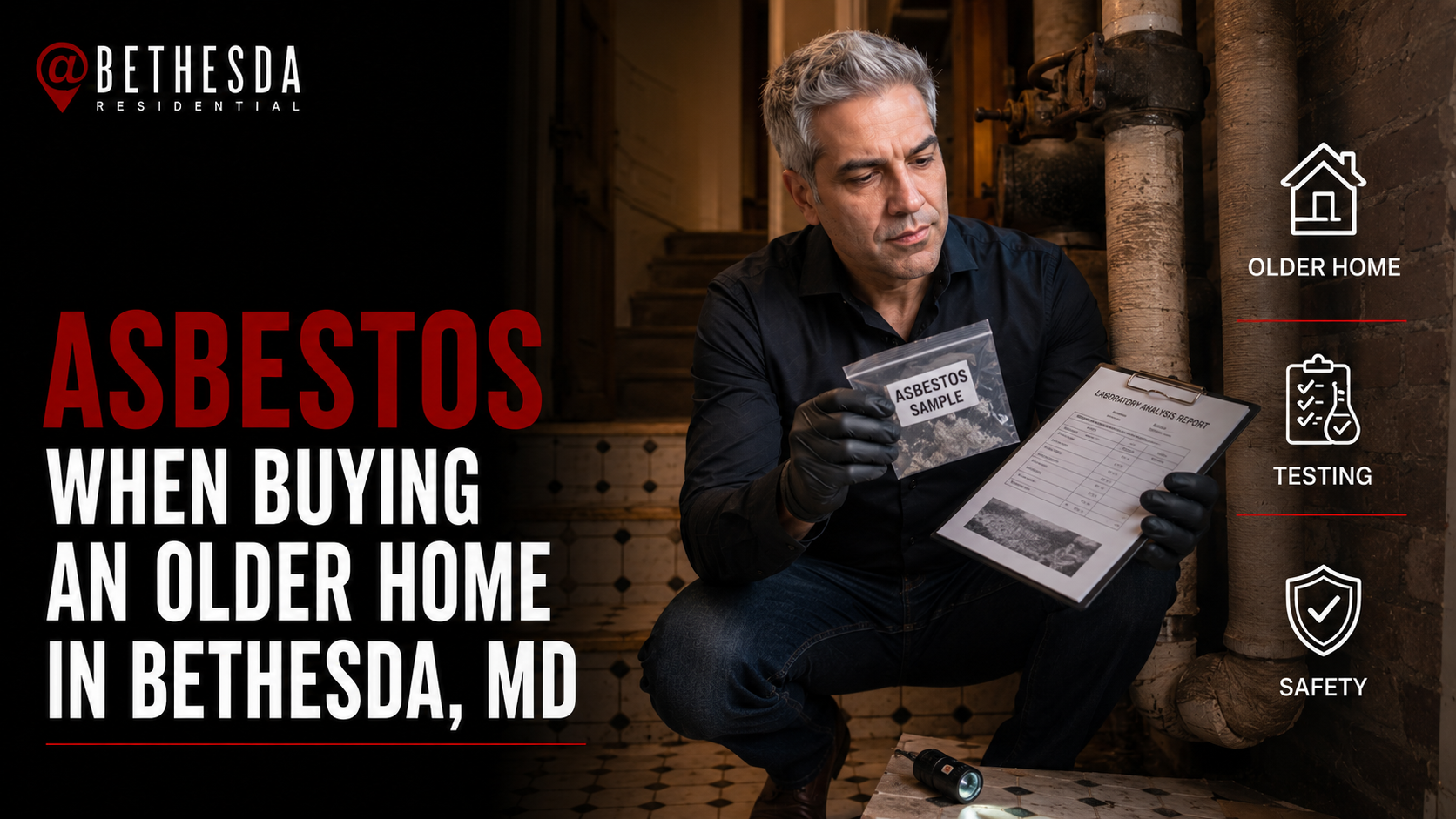
Asbestos is common in Bethesda-area homes built before 1980 — in popcorn ceilings, old floor tiles, pipe and duct insulation, and siding. A standard home inspection won't test for it; a licensed asbestos inspector charges about $250–$800 to sample and confirm. Intact, undisturbed asbestos is usually safe to leave alone, but removal runs from about $1,500 for a small area to $15,000–$30,000+ for a whole house, and homeowners insurance rarely covers it. If you plan to renovate an older home, test during your inspection period and negotiate.
Quick Answer
Asbestos is common in Bethesda-area homes built before 1980 — in popcorn ceilings, old floor tiles, pipe and duct insulation, and siding. A standard home inspection won't test for it; a licensed asbestos inspector charges about $250–$800 to sample and confirm. Intact, undisturbed asbestos is usually safe to leave alone, but removal runs from about $1,500 for a small area to $15,000–$30,000+ for a whole house, and homeowners insurance rarely covers it. If you plan to renovate an older home, test during your inspection period and negotiate.
Bethesda, Chevy Chase, and Potomac are full of the kind of homes buyers love — solid brick colonials, mid-century ramblers, and split-levels built in the 1950s, '60s, and '70s. They're well-built and beautifully located. They also went up during the decades when asbestos was in almost everything. Understanding asbestos when buying a home in one of these older neighborhoods can save you from a five-figure surprise down the road.
It's one of the quieter due-diligence items on the table. It rarely shows up on a standard inspection report, and it usually doesn't come up until you start planning a renovation. Here's what you actually need to know, what it costs, and how to handle it before you're locked into a contract.
Why asbestos when buying a home matters more in older Bethesda neighborhoods
Asbestos was used heavily in residential construction until it was phased out through the late 1970s and 1980s. Homes built before 1980 are the ones most likely to contain it — and a large share of the housing stock in Bethesda, Chevy Chase, North Bethesda, and Potomac predates that cutoff.
Here's the key thing to understand: asbestos that's intact and left alone is generally not a health hazard. It becomes dangerous when it's disturbed — during a renovation, a demolition, or when old materials break down and release microscopic fibers into the air. Breathing those fibers over time is linked to serious lung disease, including mesothelioma. That's why this matters most for buyers who plan to open up a kitchen, finish a basement, or gut a bathroom in an older home.
Where asbestos hides in a pre-1980 home
Asbestos was prized for being fire-resistant and durable, so it ended up in dozens of building products. In a typical older Bethesda-area home, the usual suspects are:
- Popcorn and textured ceilings — extremely common in homes and additions built through the 1970s.
- 9x9-inch floor tiles and the black mastic adhesive beneath them, often hiding under newer flooring.
- Pipe and duct insulation — the white wrap around old heating pipes and HVAC ducts in basements.
- Vermiculite attic insulation — a loose, pebbly fill that can contain asbestos.
- Roofing and exterior siding shingles, plus some cement board.
- Joint compound, plaster, and old adhesives around walls and fixtures.
None of these announce themselves — they look like ordinary building materials, and age alone doesn't tell you which ones contain asbestos and which don't. A 1962 rambler in Wyngate and a 1970 split-level in North Potomac might each have one problem material or a dozen. The only way to know for sure is a lab test on the specific materials in that specific house.
A standard home inspection won't catch it
This is where a lot of buyers get tripped up. A general home inspector is not licensed to test for asbestos and won't sample it. At most, a good inspector will flag "suspect materials" and recommend you bring in a specialist. If you want a real answer, you need a licensed asbestos inspector who takes physical samples and sends them to an accredited lab.
In the DC metro, that testing typically runs $250 to $800, depending on how many samples you pull. It's a small cost relative to the price of an older Bethesda home, and it's worth it if you have any renovation plans at all. This is the same window where you'd handle radon testing and review the lead paint disclosure for pre-1978 homes — treat asbestos as one more item on the older-home checklist.
What asbestos removal actually costs
If a sample comes back positive, don't panic — and don't assume you have to rip it out. Intact material in good condition can often be left in place or encapsulated (sealed) rather than removed. Removal only becomes necessary when the material is damaged, deteriorating, or in the way of a renovation.
When abatement is needed, here's the range in this market:
- Small, targeted removals (a section of pipe wrap, a small ceiling): roughly $1,500–$5,000.
- Interior work: about $5–$20 per square foot.
- Exterior siding: much higher — $50–$150 per square foot.
- Whole-home abatement: $15,000–$30,000 or more.
Two things buyers routinely miss. First, homeowners insurance usually won't pay for it — asbestos is treated as a pollutant and excluded from most policies, so this comes out of pocket. Second, abatement is a separate line item from the renovation itself. Encapsulating a wrapped basement pipe is cheap; tearing out asbestos siding on a whole house before you reside it is not. If you're already budgeting a project, add the abatement on top and fold it into your overall purchase and closing costs so the number you carry into negotiations is the real one.
How Maryland regulates it — and what the seller has to tell you
In Maryland, asbestos abatement is regulated by the Maryland Department of the Environment (MDE) under COMAR 26.11.21. Contractors who remove or encapsulate asbestos have to be MDE-licensed and follow strict handling and disposal rules.
There's a wrinkle worth knowing: single-family homes — and buildings with four or fewer units — are exempt from the facility regulations, which means a homeowner can legally do their own asbestos work in a single-family house. That doesn't make it a good idea. Friable asbestos is genuinely hazardous, and the disposal rules still apply. For anything beyond the smallest job, hire a licensed abatement contractor.
On disclosure: Maryland sellers complete the Residential Property Disclosure and Disclaimer Statement, and they're required to disclose latent defects they have actual knowledge of — including hazardous materials like asbestos. That duty holds even in an "as-is" sale and can't be waived. But it's knowledge-based. Plenty of owners of older homes have never tested, so they can honestly report no knowledge of asbestos. A clean disclosure doesn't mean the house is asbestos-free — it just means the seller doesn't know. Don't let it stand in for your own testing.
Your game plan as a buyer
If you're thinking through asbestos when buying a home in Bethesda, here's the practical sequence:
- Build testing into your inspection period. Line up a licensed asbestos inspector alongside your general inspection so you're not scrambling before the contingency expires.
- Test the areas you plan to touch. If you're renovating the kitchen or finishing the basement, sample there first — that's where cost and risk concentrate.
- Get an abatement estimate before you negotiate. A real number gives you leverage to ask for a price reduction or a closing credit.
- Decide: remove, encapsulate, or leave it. Not every finding requires removal, and that choice reshapes your budget.
One caution: in a competitive Bethesda offer, it's tempting to waive the home inspection to win the deal. On an older home you intend to renovate, that's exactly the scenario where a missed asbestos issue can cost you five figures after closing. Weigh that trade-off carefully.
Asbestos in an older Bethesda home isn't a reason to walk away — plenty of these houses are excellent buys. It's a reason to test, get real numbers, and negotiate from a position of knowledge instead of discovering the problem mid-renovation. That's the whole game with older homes: know exactly what you're buying before you're committed.
If you're weighing an older home in Bethesda, Chevy Chase, or Potomac and want help thinking through the inspection and negotiation strategy, I'm happy to walk you through it. Reach out anytime.
About Pey Behin
Pey Behin is a residential real estate agent serving the Washington, DC metro area, with a focus on Bethesda, Montgomery County, and Northern Virginia. He works with buyers and sellers who want clear strategy, data-driven pricing, and direct guidance throughout the transaction process.